Choosing a knee scooter after foot surgery can make daily movement safer, easier, and far less tiring than relying on crutches alone.
Below, we focus on the practical differences that matter most: comfort, stability, wheel size, braking, foldability, and where each type works best.
Best 10 Knee Scooter After Foot Surgery Picks for 2026
Hands-Free Recovery Option
iWALK3.0 Original Hands Free Knee Crutch

- Hands-free mobility for qualified users
- Supports daily activity and stairs
- Requires height, weight, and balance fit
Best For: Qualified adults seeking hands-free recovery mobility
Comfort Control Pick
BlessReach Knee Scooter Walker for Adults

- 8" wheels with shock absorption and curved frame
- Dual handbrakes plus rear on-wheel brakes
- Includes detachable canvas bag
Best For: Adults wanting comfort, control, and carrying convenience
All-Terrain Runner-Up
BlessReach Foldable All Terrain Knee Scooter

- 11" front wheels and 8" rear wheels
- Disc brake plus locking handbrake
- Foldable steel frame with 300 lb capacity
Best For: Outdoor recovery over grass, gravel, and rough sidewalks
All-Terrain Choice
Vive Mobility All Terrain Knee Scooter Walker

- 12-inch pneumatic wheels for uneven surfaces
- Dual rear friction brakes for added control
- Contoured knee pad and folding design
Best For: Adults recovering from foot or ankle surgery who need all-terrain stability
All-Terrain Stability Pick
BlessReach Deluxe Medical Scooter

- 11-inch front and 9-inch rear tires
- Double handbrake setup for control
- Contoured padded knee brace with bag
Best For: Adults needing a stable all-terrain knee walker for injury recovery
Compact Stability
BlessReach Dual-Brake Knee Scooter
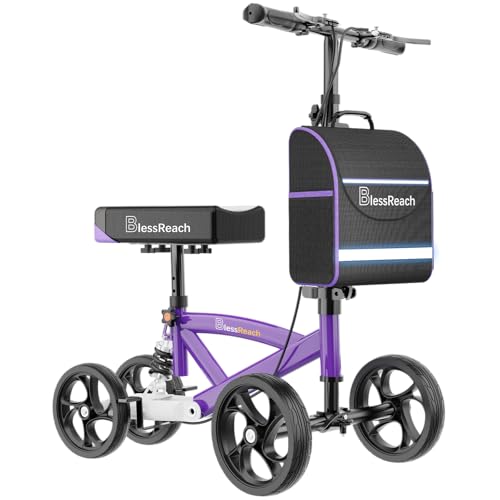
- Dual braking system for controlled stopping.
- 8-inch wheels handle smooth indoor/outdoor surfaces.
- Foldable frame with adjustable height and kneepad.
Best For: People who want a simple foldable scooter for post-surgery recovery
Budget Steerable Pick – KneeRover Economy Steerable Knee Scooter
If you need a knee scooter after foot surgery, the KneeRover Economy Steerable model is a practical crutch alternative for indoor and outdoor use. It’s built to be stable, adjustable, and easy to fold, making it a straightforward option for everyday recovery.
Best For: Adults and kids who want an affordable, steerable recovery scooter with solid everyday control.
Pros:
- Four 7.5″ rubber wheels, rear on-wheel brakes, and an adjustable locking handbrake for control.
- Lightweight 20.3 lb frame with a 300 lb. weight capacity.
- Adjustable handlebars and kneepad fit users from 4’9″ to 6’4″.
- Quick-release folding mechanism makes transport and storage easier.
Cons:
- Designed for a safe walking speed of under 3 mph.
- Not an all-terrain model for rougher surfaces.
This is a strong value pick if you want a dependable knee walker with familiar steering and braking features. It focuses on comfort, portability, and basic stability rather than premium off-road capability.
Hands-Free Recovery Option – iWALK3.0 Original Hands Free Knee Crutch
For some people recovering from foot surgery, a knee scooter after foot surgery isn’t the only option. The iWALK3.0 is a hands-free knee crutch designed to keep you upright and mobile, but it has strict fit and balance requirements, so it’s only for users who meet all qualifications.
Best For: Healthy, motivated adults who meet the height, weight, age, and balance requirements and want hands-free mobility.
Pros:
- Hands-free design can support normal daily activities, including stairs.
- Made for use indoors, outdoors, and on uneven terrain.
- Learning curve is typically 1-3 days, with personalized support included.
- Tool-free assembly and warranty coverage are included.
Cons:
- Not recommended for elderly users or anyone with balance or strength limitations.
- Requires users to meet all height, weight, age, and physique qualifications.
- There is a learning curve and some initial discomfort may occur.
This is a specialized mobility solution, not a general-purpose option. If you meet the qualifications and want to stay hands-free during recovery, it can be a major upgrade over crutches or a traditional knee scooter.
Comfort Control Pick – BlessReach Knee Scooter Walker for Adults
If you’re shopping for a knee scooter after foot surgery, this BlessReach walker aims for a balance of comfort and control. It’s designed as a crutch alternative for foot, ankle, and lower-leg recovery, with adjustable fit features and a detachable bag for everyday convenience.
Best For: Adults who want a steerable knee walker with dual handbrakes, a bag, and a stable indoor-outdoor ride.
Pros:
- Curved bottom frame and shock absorption are meant to improve comfort and support.
- 8″ front and rear wheels help with maneuvering.
- Dual adjustable locking handbrakes and dual rear on-wheel brakes add control.
- Detachable canvas bag is included for carrying items.
Cons:
- Designed for a safe walking speed of less than 3 mph.
- Not the lightest option at about 20 pounds.
This model is a solid middle-ground choice if you want practical adjustability and braking control. It’s geared toward everyday recovery use rather than specialty terrain performance.
All-Terrain Runner-Up – BlessReach Foldable All Terrain Knee Scooter
When a knee scooter after foot surgery needs to handle rougher ground, this BlessReach all-terrain model stands out. It’s built for users recovering from foot, ankle, calf, or knee injuries who need more capable wheels, stronger braking, and a foldable frame for storage.
Best For: Users who need a foldable all-terrain knee scooter for grass, gravel, dirt, and uneven sidewalks.
Pros:
- 11″ front wheels and 8″ rear wheels are designed for all-terrain use.
- Disc brake system plus locking handbrake provides stronger control.
- Six-level adjustable knee pad and handlebars help with fit.
- Heavy-duty steel frame supports up to 300 lb. and folds for transport.
Cons:
- At 25.6 lb., it is heavier than basic knee scooters.
- Higher-spec design may be more than needed for simple indoor recovery.
This is the most terrain-capable option in the group, especially if you expect to roll beyond smooth floors and sidewalks. It trades some portability for better outdoor versatility and braking hardware.
All-Terrain Choice – Vive Mobility All Terrain Knee Scooter Walker
If you need a knee scooter after foot surgery and expect to move over more than just smooth indoor floors, this all-terrain model is built for that job. The 12-inch pneumatic wheels, dual rear friction brakes, and contoured knee pad are designed to make recovery travel feel steadier and more comfortable than standard crutches.
Best For: Adults who want a stable knee scooter for mixed surfaces like carpet, gravel, grass, dirt, and pavement.
Pros:
- 12-inch pneumatic wheels are made for stable rolling on uneven surfaces
- Dual rear friction brakes add control on inclines and rough ground
- Contoured foam knee pad helps distribute pressure more evenly
- Folds for storage and includes an attached storage bag
Cons:
- All-terrain setup may be more scooter than needed for simple indoor-only use
- Height range is specific, so fit should be checked carefully
Overall, this is a practical pick if your recovery involves navigating varied terrain and you want a knee scooter that emphasizes stability, comfort, and easier transport.
Compact Budget Pick – BlessReach Lightweight Knee Scooter
For a knee scooter after foot surgery that aims to keep things simple and transport-friendly, this BlessReach model focuses on the essentials. It uses 8-inch rubber wheels, a double-tube frame for support, and an adjustable locking handbrake, making it a straightforward crutch alternative for everyday recovery movement.
Best For: Adults who want a foldable knee walker that is easy to move, store, and fit in a car.
Pros:
- Lightweight, foldable main frame helps with transport and storage
- 8-inch rubber wheels are easy to maneuver
- Adjustable locking handbrake adds safety and control
- Detachable canvas bag gives you a place to carry small items
Cons:
- Standard wheel setup is less terrain-focused than all-terrain options
- Height range and sizing should be checked for a proper fit
This is a practical pick if you want a compact recovery scooter with the core features most people need, without extra bulk or complexity.
All-Terrain Stability Pick – BlessReach Deluxe Medical Scooter
If you are shopping for a knee scooter after foot surgery and want a model built for steadier outdoor movement, this BlessReach deluxe scooter is designed around all-terrain use. Its 11-inch front tires, 9-inch rear tires, contoured padded knee brace, and double handbrake setup are aimed at making recovery travel more controlled and comfortable.
Best For: Adults recovering from foot, ankle, or calf injuries who want an all-terrain knee scooter with strong support.
Pros:
- All-terrain tire setup helps handle grass, gravel, dirt, and sidewalk gaps
- Contoured padded knee brace is built for more comfortable support
- Double handbrake design adds stopping control
- Removable canvas bag and foldable parts help with transport and storage
Cons:
- Listing does not emphasize a folding frame in the same way as some compact models
- May be more scooter than needed for users who stay mostly indoors
For buyers who value stability and outdoor capability, this model offers a balanced mix of comfort, control, and practical storage features.
Compact Stability – BlessReach Dual-Brake Knee Scooter
If you need a knee scooter after foot surgery for everyday indoor use, this BlessReach model is built around simple control, foldability, and steady movement. Its dual braking system, 8-inch wheels, and 300 lb capacity make it a practical crutch alternative for recovery around the home, work, or store.
Best For: Users who want a foldable, easy-to-handle knee scooter with solid basic stability for smooth indoor and outdoor surfaces.
Pros:
- Dual braking system for safer slowing and stopping.
- 8-inch front and rear wheels for smoother rolling on many surfaces.
- Foldable design with detachable features for easier transport and storage.
- Adjustable handlebars and kneepad suit a wide height range.
Cons:
- Best suited to smooth ground rather than rough terrain.
- Recommended speed is limited to 2.4 mph.
Overall, this is a straightforward recovery scooter for buyers who value practicality and stable everyday mobility over extra terrain features. It covers the core needs well without adding much complexity.
All-Terrain Control – BlessReach 11-Inch Wheel Knee Scooter
If you’re shopping for a knee scooter after foot surgery and expect to move across rougher ground, this BlessReach all-terrain version is designed for more demanding routes. The 11-inch front wheels, disc brakes, and shock absorbers are aimed at improving control and comfort on grass, gravel, dirt, and sidewalk crevices.
Best For: Buyers who need stronger braking and bigger wheels for mixed indoor/outdoor mobility.
Pros:
- Industry-first disc brakes with handbrake parking function.
- 11-inch front wheels and 8-inch rear wheels for all-terrain use.
- Shock absorbers help reduce vibration during movement.
- Lightweight aluminum frame supports up to 300 lb and folds for transport.
Cons:
- May be more scooter than needed if you only travel on smooth floors.
- Large wheels can be less compact than standard 8-inch models.
This model makes sense if terrain is a real concern during recovery and you want more braking control than a basic knee walker. It trades a little compactness for better ride confidence.
Comfort First – Aojin Adjustable Knee Scooter
For a knee scooter after foot surgery that focuses on comfort and easy daily use, the Aojin model keeps things practical. It pairs a thickened knee pad with dual handbrakes, adjustable fit points, and 8-inch rubber wheels, making it a solid option for indoor and outdoor recovery trips.
Best For: Users who want a comfortable, easy-to-adjust knee scooter with a padded knee rest for daily recovery.
Pros:
- Thickened 13-inch knee pad adds comfort during longer use.
- Dual height adjustment helps fit users from 4’7″ to 6’1″.
- 8-inch rubber wheels offer wear and slip resistance.
- Folds for storage and includes a removable storage bag.
Cons:
- 8-inch wheels are better for smooth surfaces than rough terrain.
- Not the lightest option at 10 kg.
Compared with more terrain-focused scooters, this one leans into comfort, adjustment, and easy everyday handling. It is a balanced pick if you want dependable basics without extra bulk or specialized off-road features.
How We Picked the Best Knee Scooter After Foot Surgery
To narrow down the best Knee Scooter After Foot Surgery options, we looked for models that balance support, maneuverability, adjustability, and real-world convenience. Important filters included weight capacity, steering control, brake quality, portability, and whether the scooter is better suited for indoor use, outdoor use, or mixed terrain.
We also favored designs with comfortable knee pads, easy height adjustments, and folding frames, since recovery mobility gear should reduce strain rather than create new hassles.
Quick Comparison
The main differences usually come down to wheel size, brake setup, and frame style. Smaller wheels tend to feel lighter and work well indoors on smooth floors. Larger all-terrain wheels are better for sidewalks, driveways, and uneven paths. Models with dual brakes generally offer more confidence on slopes and during turns, while compact foldable designs are easier to store and transport.
Key Buying Factors for Knee Scooter After Foot Surgery
Comfort and Fit
A supportive knee platform matters most if you expect to use the scooter for more than a few days. Look for adequate padding, enough platform length for your leg, and handlebars that adjust to your height so you can stay upright without hunching.
Stability and Control
Steering responsiveness, brake performance, and overall frame width affect how secure the scooter feels. If you are recovering from surgery and want extra confidence, prioritize a stable base and reliable handbrakes.
Terrain and Wheel Size
Choose wheel size based on where you’ll use it. An indoor-focused Knee Scooter After Foot Surgery can work well with smaller wheels, but larger wheels are often better if you need to cross cracks, thresholds, or rough pavement.
Portability and Storage
If you plan to drive, travel, or store the scooter in a small home, foldability is a major advantage. Lighter models are easier to lift, while heavier all-terrain scooters may offer more confidence outside.
Weight Capacity and Durability
Always check the listed capacity against your body weight and any gear you may carry. A stronger frame can improve long-term reliability, especially for extended recovery periods.
Who Should Buy Which Knee Scooter After Foot Surgery?
If you want the simplest option for home use, a compact steerable model is usually the best fit. If you expect to move across mixed surfaces, an all-terrain scooter with larger wheels and stronger brakes is the smarter choice. If you need maximum portability, look for a lightweight foldable frame. And if you’re considering a hands-free alternative, verify that your balance, strength, and surgeon’s guidance make it appropriate for your recovery needs.
In short, the best Knee Scooter After Foot Surgery is the one that matches your space, your terrain, and how much support you need during healing.