Resistance Bands for Working Out is a simple product, but the details matter.
This set is built for people who want a portable, fabric-based option for lower-body training, mobility work, or rehab-style resistance.
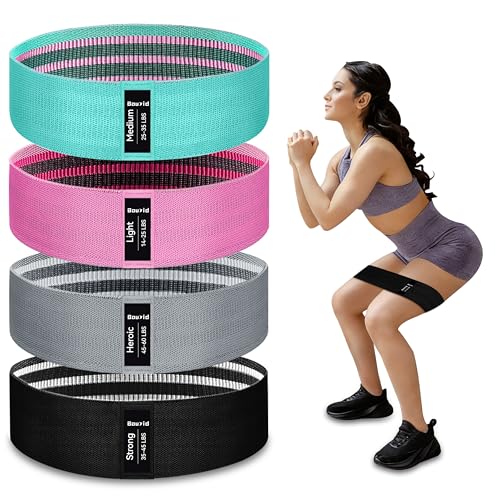
Resistance Bands for Working Out Review Summary
If you want a compact training tool that can support a range of effort levels without taking over your bag or room, Resistance Bands for Working Out is easy to understand and easy to justify.
The listing positions it as a four-level set for women and men, with fabric construction, anti-slip positioning, and a carry bag that makes it practical for home, office, or travel use.
What stands out most is the way the product tries to balance comfort, durability, and progression.
The four resistance levels make it more flexible than a single-band buy, while the fabric design should appeal to buyers who dislike thin rubber bands that roll or dig in.
That makes this a strong fit for beginners building consistency, intermediate users adding glute and leg accessories to a routine, and people doing lighter physical therapy or movement work.
Review Scorecard
| Category | Score | Buyer-focused rationale |
|---|---|---|
| Progression range | 8/10 | Four labeled levels make it easier to match effort to exercise and grow over time. |
| Comfort | 8/10 | The listing emphasizes elastic fabric, skin-friendly wear, and a design meant to feel more comfortable than slick latex bands. |
| Portability | 9/10 | The included storage bag and compact format suit home, office, and outdoor use. |
| Stability | 8/10 | Fabric construction is presented as anti-slip, which matters for leg and booty-band work. |
| Training versatility | 8/10 | The bands are positioned for workout, yoga, Pilates, and rehab-style use. |
| Value for beginners | 9/10 | The set format and broad use cases make it an approachable first resistance band purchase. |
Bottom line: this is a practical, low-friction band set for buyers who want convenience and versatility more than specialized gym equipment.
Key Features and Specifications of Resistance Bands for Working Out
The listing describes a four-band set with clearly separated resistance levels: light at 14-25 lb, medium at 25-35 lb, strong at 35-45 lb, and super at 45-60 lb.
That spread is useful because it gives the user room to progress without immediately replacing the whole set.
The bands are made from elastic fabric rather than a thin rubber loop.
The listing frames that choice as a comfort and durability upgrade, and that is exactly the main selling point for many buyers.
Fabric bands are often preferred when the goal is repeated lower-body work and less fuss during movement.
Other practical details matter too:
- The set includes a storage bag.
- The product is positioned for home, office, and outdoor use.
- The listing says it can support workout, yoga, Pilates, leg training, and physical therapy-style routines.
- The guidance material is described as helping the user work the whole body.
- The brand frames it as a giftable fitness item for different occasions.
If you are comparing this to generic loop bands, the biggest difference is the material and the way the product is presented around comfort and stability.
If you are comparing it to heavier gym equipment, the real advantage is simplicity.
It is not trying to be a full home gym.
It is trying to be the small tool you will actually keep using.
Pros and Cons of Resistance Bands for Working Out
Pros
- Four resistance levels make the set useful for progression.
- Fabric construction should be more comfortable than thin, rolling bands.
- The anti-slip design is a strong match for glute and leg exercises.
- The storage bag improves portability.
- The product is versatile enough for workout, yoga, Pilates, and rehab-oriented movement.
Cons
- The listing is focused on broad use cases, not highly specific training metrics.
- Buyers looking for exact stretch data, dimensions, or material composition detail will not find much here.
- This is best understood as an accessory tool, not a replacement for heavier strength equipment.
- The value depends on whether you want a fabric loop band set rather than a latex-style band system.
The pros are compelling if your priority is consistency.
The cons are mostly about expectations: this is intentionally a simple product, so it is less appealing if you want deep technical specs or a more advanced resistance system.
Who Should Buy Resistance Bands for Working Out?
Buy this if you want a compact, low-commitment training accessory. The four levels make the set suitable for people starting out and for users who want a clear way to step up intensity over time.
Buy this if comfort matters more than maximal load. The fabric build is likely the main reason to choose it over basic rubber loops.
If you use bands for squats, hip work, abduction drills, warmups, or mobility sessions, that matters.
Buy this if you need something portable. The included bag and the home/office/outdoor framing make it a reasonable pick for people who train in more than one place.
Buy this if you are rehabbing or easing back into exercise. The listing explicitly points to physical therapy-style use and adjustable intensity, which is a good sign for users who want controlled resistance rather than aggressive loading.
Skip it if you want one band for everything. A set is better than a single band for progression, but if you only need one resistance level, this may be more than you need.
Skip it if you need precise strength programming. The listing gives resistance ranges, but not the kind of detailed performance data that advanced lifters may want.
Fabric Band Design and Training Use
Four Resistance Levels
The clearest reason to consider this set is the stepwise resistance range.
Light through super gives you a simple progression path, and that is especially useful for lower-body accessory work where a small jump in tension can change the feel of an exercise a lot.
Comfort and Anti-Slip Feel
The product is built around high-quality elastic fabric and a knit construction that is described as skin-friendly and durable.
For buyers who have had latex or rubber bands slide, pinch, or roll, that design choice is the main selling point.
Home, Office, and Travel Convenience
This is the kind of product you can leave in a drawer or toss in a bag.
The storage bag and compact format make it easy to fit movement into a day without planning a full workout around it.
Rehab and Routine Support
The listing’s physical therapy angle makes sense because resistance bands work well when you want controlled tension and repeatable movement.
That does not make the product medical equipment, but it does make it relevant for gentle strength work and mobility routines.
Alternatives to Resistance Bands for Working Out
If you want a comparable fabric loop set, look at Miera fabric resistance bands.
If you prefer a well-known general fitness line, search for Letsfit resistance bands.
If you want a broader training ecosystem with multiple band styles, Fit Simplify resistance bands is a common Amazon search path.
If you are focused on glute and leg work specifically, booty resistance bands will surface many similar sets.
The right alternative depends on whether you want fabric comfort, a more traditional latex band feel, or a branded bundle with different accessories.
This product leans toward comfort and portability first.
Is Resistance Bands for Working Out Worth It?
Yes, for the right buyer. Resistance Bands for Working Out is worth considering if you want a fabric band set with multiple resistance levels, easy portability, and a comfort-first design for lower-body training and general movement work.
It is especially sensible for beginners, home exercisers, and buyers who want a practical option for yoga, Pilates, glute work, or lighter rehabilitation routines.
If you need detailed technical specs or a heavier-duty strength tool, look elsewhere.
If you want a simple set you are likely to use, this one makes sense.