Sleeping after shoulder or arm surgery can be difficult when a standard bed pillow lets your arm shift or puts pressure on a tender area. A purpose-shaped cushion may help you maintain the position your care team recommends.
These 10 options include shoulder-support pillows, strap-equipped cushions, and arm-elevation wedges. The best choice depends on your procedure, prescribed positioning, and how you sleep.
Best 10 Arm Pillow for Sleeping After Surgery Picks for 2026
Best for Side Sleepers
W-Shaped Shoulder Support Pillow

- 23.5 x 14 x 6-inch W-shaped design
- Soft hollow-fiber fill
- Removable, washable cover
Best For: Side sleepers seeking shoulder and arm support
Best for Ice-Pack Access

- Two pockets intended for ice
- Grooved foam elevation wedge
- Removable zippered pillowcase
Best For: Elevated arm rest with ice pockets
Best for Arm Stability
Grooved 30-Degree Elevation Wedge

- Groove with raised sides
- Stated 30-degree incline
- Washable, removable flannel cover
Best For: Keeping an elevated arm nestled in place
Most Versatile Wedge
TYYIHUA Arm and Leg Elevation Pillow

- Wide, inclined arm groove
- Also described for leg elevation
- Washable cover with carry handle
Best For: Arm elevation with occasional leg support
Compact Strap-Free Pick
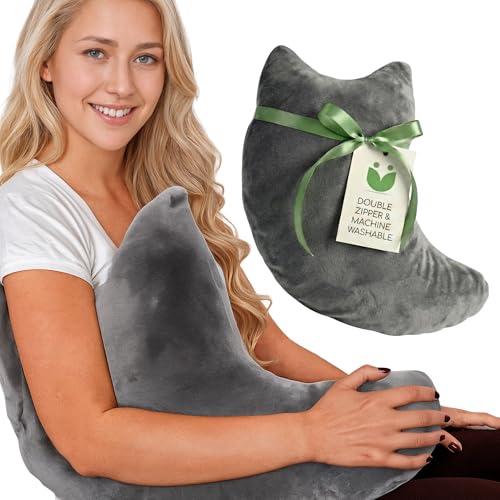
- Compact L-shaped upper-arm support
- Adjustable polyester fill
- Machine-washable outer cover
Best For: Simple, strap-free shoulder support
Most Adjustable
Memory Foam Shoulder Pillow with Pockets

- Customizable shredded memory foam
- Adjustable, removable arm and shoulder straps
- Two pockets; supports either arm
Best For: Customizable full-arm positioning
Strapped Side-Sleeping Pick
J-Shaped Shoulder Support Pillow

- Detachable hook-and-loop strap
- Broad 23-by-15-inch J-shape
- Removable, washable plush cover
Best For: Keeping arm support positioned while sitting or side sleeping
Compact Arm Cradle

- Grooved design with raised sides
- Soft polypropylene-fiber fill
- Hand wash only
Best For: Compact arm or hand support during rest
Roll-Up Support

- Opens flat or rolls with a strap
- Grooved arm-resting surface
- Lightweight and machine washable
Best For: Portable, flexible arm elevation
Shoulder-Focused Support

- W-shaped multi-angle support
- Supports shoulder through elbow
- Removable, washable cover
Best For: Shoulder and upper-arm positioning while resting
Best for Side Sleepers – W-Shaped Shoulder Support Pillow
If you’re looking for an arm pillow for sleeping after surgery, this W-shaped option is designed to support the shoulder, bicep, or elbow. At 23.5 x 14 x 6 inches, it offers a broader resting surface than the compact elevation wedges in this roundup.
Best For: Side sleepers who want soft, targeted shoulder and arm support.
Pros:
- W-shaped design supports several arm positions.
- Hollow-fiber fill and micro-plush cover balance softness and support.
- Zippered cover is removable and machine washable.
Cons:
- Its larger footprint may take up more bed space.
- Not described as an inclined elevation wedge.
Choose this one when comfortable shoulder positioning matters more than raising the arm on a defined incline.
Best for Ice-Pack Access – Buryeah Arm Elevation Pillow
This arm pillow for sleeping after surgery combines a grooved elevation wedge with two surface pockets intended for ice. Its plush exterior and foam fill offer a supported place to rest an arm or wrist in bed.
Best For: Adults who want an elevated arm rest with convenient pockets for ice.
Pros:
- Center groove helps position the arm on the wedge.
- Two pockets accommodate ice during rest.
- Zippered pillowcase removes for cleaning.
Cons:
- Vacuum-packed pillow may need about 48 hours to regain its shape.
- At 15.75 x 9.45 inches, its resting area is more compact than the W-shaped shoulder pillow.
The ice pockets distinguish this wedge; check that its dimensions suit the length of arm you want supported.
Best for Arm Stability – Grooved 30-Degree Elevation Wedge
For an arm pillow for sleeping after surgery that helps keep the arm positioned, this wedge has a grooved center and raised sides. Its stated 30-degree angle provides an inclined resting position for the arm, wrist, or elbow.
Best For: Adults who prefer a more enclosed groove to limit side-to-side arm movement.
Pros:
- Raised sides and center groove help cradle the arm.
- Foam wedge provides inclined support.
- Removable flannel cover is machine washable.
Cons:
- Vacuum packing requires 24–48 hours for full expansion.
- Fixed wedge shape offers less positioning flexibility than a loose-fill pillow.
This is a practical pick if keeping the arm nestled in one place is your priority; its listed unfolded size is about 15.57 x 9.4 x 7.9 inches.
Most Versatile Wedge – TYYIHUA Arm and Leg Elevation Pillow
This arm pillow for sleeping after surgery uses a wide groove and inclined foam design to support an arm at rest. The maker also describes it as suitable for elevating the legs, giving it a second use beyond arm support.
Best For: Adults who want one wedge for arm elevation and occasional leg support.
Pros:
- Wide groove leaves space for positioning the arm.
- High-resilience foam is designed for lasting support.
- Breathable, machine-washable cover includes a carry handle.
Cons:
- Needs at least 24 hours to regain its shape after unpacking.
- Supplied details do not give dimensions for checking fit before purchase.
The carry handle and dual-use design make this a convenient option, though shoppers who need a specific arm-rest size may prefer a wedge with published measurements.
Compact Strap-Free Pick – L-Shaped Rotator Cuff Pillow
If you want an arm pillow for sleeping after surgery without straps to adjust, this compact L-shaped option tucks under your upper arm and shoulder. Its medium-firm polyester fill can be adjusted through an inner zipper to suit your preferred level of support.
Best For: Adults who want simple, strap-free shoulder support while resting in bed, on a couch, or in a recliner.
Pros:
- Compact 13.2-by-8.2-by-6.9-inch shape supports the shoulder and upper arm without taking up full-body-pillow space.
- Adjustable fill helps customize the fit.
- Removable velvet outer cover can be machine-washed cold.
Cons:
- No strap to hold it in place when you change positions.
- Inner fill is not machine-washable; the cover must be laid flat to dry.
This is a straightforward choice if you prefer to position a pillow under your arm rather than fasten one on. Check the dimensions if you need support extending farther down your arm.
Most Adjustable – Memory Foam Shoulder Pillow with Pockets
For shoppers comparing an arm pillow for sleeping after surgery, this larger model offers several ways to fine-tune the fit. You can add or remove shredded memory foam and adjust or remove its cushioned shoulder and upper-arm straps; a cushioned hand strap provides another resting point.
Best For: Adults who want customizable, full-arm positioning with straps and room for small essentials.
Pros:
- Adjustable fill and removable shoulder and arm straps allow a personalized setup.
- Supports either the right or left arm and includes two storage pockets.
- Breathable lyocell cover is removable and machine-washable.
Cons:
- At 23 by 16.5 by 6.75 inches, it takes up more space than a compact under-arm pillow.
- Multiple straps may be more than you want if you prefer a simple tuck-in design.
Its adjustability is the main reason to choose it, particularly if your preferred arm position changes between sitting and resting. Follow the cover’s cold, gentle-wash instructions; line drying is recommended.
Strapped Side-Sleeping Pick – J-Shaped Shoulder Support Pillow
If you need an arm pillow for sleeping after surgery that can stay tucked under your arm, this J-shaped option includes a detachable hook-and-loop strap. The strap can help secure the pillow while sitting or standing and can be positioned around the shoulder for side sleeping.
Best For: Adults who want a larger arm-support pillow with a detachable strap for sitting or side sleeping.
Pros:
- Detachable strap helps hold the pillow in place without continuously gripping it.
- 23-by-15-inch J-shape provides a broad area for arm support.
- Soft plush cover has a zipper for removal and washing.
Cons:
- Its larger footprint may be less convenient in a crowded bed or chair.
- A hook-and-loop strap adds a fastening step compared with strap-free pillows.
Choose this one if keeping an under-arm pillow positioned is your priority. Its strap and broad shape distinguish it from a small support pillow, though you’ll need to allow room for its 23-inch length.
Compact Arm Cradle – Soaoo Arm Support Pillow
If you need an arm pillow for sleeping after surgery, the Soaoo offers a soft, grooved place to rest an arm or hand. Its raised sides help keep the limb positioned, and it can also support a leg while resting.
Best For: Adults who want a compact, soft cushion for arm or hand elevation during recovery.
Pros:
- Central slit and raised sides cradle the resting limb.
- Polypropylene-fiber fill is designed for softness and resilience.
- Can be used for arm, hand, shoulder, or leg support.
Cons:
- Hand wash only.
- Vacuum-packed pillow may need about 24 hours to regain its shape.
- The notes give conflicting dimensions, so confirm sizing before purchase.
This is a straightforward option if you prefer a soft cradle over a large wedge. Check the dimensions against your intended sleeping position, especially given the inconsistent size information supplied.
Roll-Up Support – NEAUDE Arm Elevation Pillow
For shoppers comparing an arm pillow for sleeping after surgery, the NEAUDE stands out for its two configurations. Lay it open for grooved arm support, or secure it rolled up with its strap for a more compact bolster.
Best For: Adults who want a portable pillow that can switch between an arm cradle and a rolled support.
Pros:
- Groove helps position the arm when the pillow is expanded.
- Strap allows it to roll up for arm, elbow, or ankle support.
- Soft flannel fabric and lightweight construction suit travel.
- Listed as machine washable.
Cons:
- Soft fill may not suit someone seeking a firm wedge.
- Vacuum-packed pillow may take up to 48 hours to fully expand.
Its adaptable shape is the main reason to choose it: the open configuration offers a resting channel, while the rolled configuration is easier to pack and reposition. Allow time for the fill to expand before relying on its final height.
Shoulder-Focused Support – Rotator Cuff Shoulder Pillow
If your search for an arm pillow for sleeping after surgery is centered on shoulder positioning, this W-shaped pillow supports more than the forearm. Its contours are designed to rest the shoulder, upper arm, bicep, and elbow while lying down or sitting.
Best For: Adults seeking broader shoulder and upper-arm support, including side sleepers.
Pros:
- W-shaped profile offers multiple resting angles.
- Designed for shoulder, upper-arm, bicep, and elbow support.
- Removable micro-plush velour cover is machine washable.
Cons:
- At 23.5 x 14 x 6 inches, it takes up more space than a small arm cushion.
- Plush hollow-fiber fill may not appeal to those who prefer a rigid support.
Choose this one when supporting the shoulder and upper arm matters more than packing a compact pillow. Its washable cover is a practical advantage for regular use during recovery.
How We Picked the Best Arm Pillow for Sleeping After Surgery
We grouped the 10 selected products by their stated purpose and listed design features: shoulder support, arm elevation, side-sleeping support, straps, and washable covers. Those details help narrow the choices, but a product name alone cannot confirm its dimensions, firmness, or suitability for your procedure. Check the current listing and your clinician’s instructions before buying.
Quick Comparison: Which Pillow Type Fits Your Needs?
Shoulder-support pillows are intended to cushion the arm near the torso and may be useful when a sling or prescribed resting position needs extra support. Strap-equipped pillows may be easier to keep in place when changing position, provided the strap does not conflict with your sling or incision. Elevation wedges are designed to raise the arm and may suit someone instructed to elevate a hand, wrist, or forearm. Side-sleeper designs target a specific sleep position; use one only if side sleeping is permitted during your recovery.
Key Buying Factors for an Arm Pillow for Sleeping After Surgery
Follow the Prescribed Position First
Ask your surgeon or physical therapist whether your arm should be elevated, kept close to your body, supported in a sling, or protected from certain movements. The right Arm Pillow for Sleeping After Surgery should help maintain that position without pushing your shoulder, elbow, or wrist into an uncomfortable angle. Do not substitute a pillow for a prescribed sling or immobilizer.
Check Height, Shape, and Bed Fit
Compare the pillow’s dimensions with your arm length, mattress space, and usual sleep position. An elevation wedge should support enough of the forearm to avoid concentrating pressure at the elbow or wrist. A shoulder cushion should fit alongside your torso without crowding your neck or rolling you onto the operated side. If the listing omits measurements, ask the seller before ordering.
Prioritize Stability and Easy Care
Look for a shape that resists slipping as you settle in. If you choose a strap, check how it fastens and whether it can be adjusted without pressing on sensitive areas. A removable, washable cover can make routine cleaning easier; verify the care instructions, since not every pillow or foam insert is machine washable.
Who Should Buy Which Arm Pillow for Sleeping After Surgery?
After shoulder or rotator cuff surgery: start with a shoulder-support pillow that complements your prescribed sling and sleeping position. For a hand, wrist, or forearm that must be raised: compare elevation wedges by height and the length of support they provide. For frequent repositioning: consider a secure-fitting design, but avoid anything that restricts circulation or pulls on the surgical area. For side sleepers: confirm when that position is allowed before choosing a pillow marketed for it.
If you are unsure which shape is appropriate, bring the product dimensions or a photo to your care team. Comfort matters, but your post-operative positioning instructions should decide the purchase.