A damp basement can lead to musty odors, condensation, mold growth, and damage to stored belongings. The right dehumidifier helps control excess moisture while making the space more comfortable year-round.
We selected 10 basement-focused models across several room sizes and capacity ranges, including options with continuous drainage, built-in pumps, Energy Star efficiency, and automatic humidity controls.
Best 10 Dehumidifiers for Basements Picks for 2026
Most-Efficient Large-Basement Pick

- ENERGY STAR Most Efficient 2025 claim
- Up to 5,500 sq. ft. coverage
- Automatic defrost and power-off memory
Best For: Large basements and efficiency-focused households
Quiet Mid-Size Basement Choice

- Covers up to 2,500 sq. ft.
- 32 dB quiet operation
- Includes hose and three operating modes
Best For: Medium basements needing quiet, flexible moisture control
High-Capacity Drainage Pick
KNKA 80-Pint Basement Dehumidifier

- Rated for up to 5,500 sq. ft.
- Includes 6.56-foot continuous-drain hose
- Auto, Dry, and Setting modes
Best For: Large basements with a continuous drainage setup
Large-Space All-Rounder
- Covers up to 5,000 sq. ft.
- 90-degree auto-swing airflow
- Adjustable 30%–80% RH control
Best For: Large basements needing broad airflow and flexible drainage
Best Balanced Pick
- 34-pint daily moisture removal
- 30%–80% adjustable humidity control
- Drain hose, timer, and rolling casters
Best For: Typical basements and residential rooms up to about 2,000 square feet
Best for Large Spaces
80-Pint Energy Star Dehumidifier

- Up to 80 pints per day
- Advertised coverage up to 5,000 sq. ft.
- 1.72-gallon tank and continuous drainage
Best For: Large basements, garages, and spaces up to a stated 5,000 square feet
Best Pumped Drainage
avylo 90-Pint Basement Dehumidifier

- Up to 90 pints per day
- Built-in pump with 15-foot lift
- Three drainage options and 2.11-gallon tank
Best For: Large basements needing long-distance or pumped continuous drainage
Best Large-Capacity Pick
4500 Sq. Ft. Energy Star Basement Dehumidifier

- Covers spaces up to 4,500 sq. ft.
- Adjustable 45–80-pint moisture removal
- Tank and continuous-hose drainage options
Best For: Large basements and whole-home moisture control
Best Energy-Efficient Compact Pick
Waykar 34-Pint Basement Dehumidifier

- Covers spaces up to 2,000 sq. ft.
- 2025 ENERGY STAR Most Efficient certified
- Operates as quietly as 38dB
Best For: Medium basements and energy-conscious households
Best Targeted-Drying Pick
4500 Sq. Ft. Basement Dehumidifier

- Covers spaces up to 4,500 sq. ft.
- 90-degree adjustable air outlet
- 1.72-gallon tank with hose drainage
Best For: Large basements needing directed airflow and continuous drainage
Most-Efficient Large-Basement Pick – AEOCKY 80-Pint Dehumidifier
For shoppers comparing dehumidifiers for basements, the AEOCKY RHEA-001 stands out for its claimed ENERGY STAR Most Efficient 2025 certification, high extraction capacity, and low-temperature operation. It is designed for large homes and damp basement conditions, with performance rated at up to 56 pints per day under typical basement conditions.
Best For: Large basements and homeowners prioritizing certified energy efficiency.
Pros:
- Rated for spaces up to 5,500 square feet.
- Removes up to 56 pints per day in stated basement conditions and up to 80 pints in hotter, more humid conditions.
- Designed to operate in lower temperatures with automatic defrost support.
- Power-off memory supports automatic restart after power restoration.
Cons:
- Its large capacity may be more than needed for smaller rooms.
- The stated extraction figures are based on specific high-temperature, high-humidity test conditions.
This is a strong option when basement coverage and operating efficiency matter more than compact size. Verify the space rating and drainage setup before buying.
Quiet Mid-Size Basement Choice – BANABIE 32-Pint Dehumidifier
The BANABIE 32-pint unit is a practical choice for shoppers seeking dehumidifiers for basements up to 2,500 square feet. Its automatic, continuous, and custom modes let you maintain a target humidity level, while the included hose supports gravity drainage during extended use.
Best For: Medium-size basements where quiet operation and simple drainage are priorities.
Pros:
- Rated to cover up to 2,500 square feet and remove 32 pints per day under stated test conditions.
- Offers automatic, continuous, and custom humidity modes with targets from 30% to 90% RH.
- Quiet operation is rated at 32 dB.
- Includes a 3.28-foot hose, auto-defrost, child lock, timer, and power-outage memory.
Cons:
- The 0.66-gallon tank is relatively small compared with the daily extraction capacity.
- Gravity drainage requires a suitable drain location and setup.
Choose this model if you want a compact, quiet unit with flexible controls. For a very wet basement, plan to use the hose rather than relying on frequent tank emptying.
High-Capacity Drainage Pick – KNKA 80-Pint Basement Dehumidifier
For large, persistently damp areas, the KNKA is one of the more feature-heavy dehumidifiers for basements in this roundup. It is rated for up to 5,500 square feet and includes a 1.45-gallon internal tank, a 6.56-foot drain hose, humidity monitoring, and multiple operating modes.
Best For: Large residential spaces where continuous drainage and high moisture removal are important.
Pros:
- Rated for up to 5,500 square feet and up to 80 pints per day in stated humid conditions.
- Includes a 6.56-foot hose for continuous drainage and a 1.45-gallon internal tank.
- Offers Auto, Dry, and Setting modes, with adjustable targets from 30% to 80% RH.
- Features real-time humidity display, indicator lighting, casters, washable filter, and child lock.
Cons:
- An optional external tank is sold separately.
- The listed specifications state 220 volts, so verify electrical compatibility before purchase.
- Reported operating noise is 40–45 dB, rather than ultra-quiet.
This model makes the most sense for a large basement with a convenient floor drain or other continuous-drain destination. Check the voltage specification carefully and keep the unit upright as directed before use.
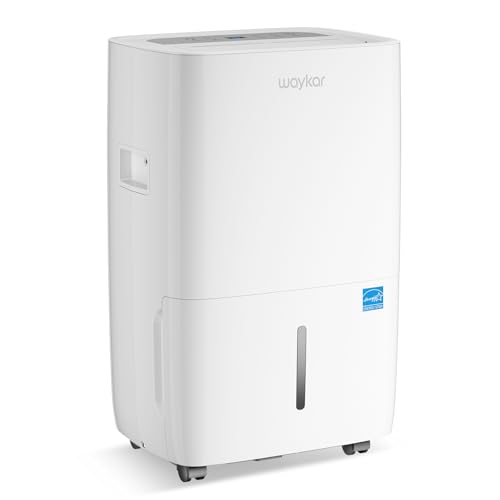
Large-Space All-Rounder – Waykar 80-Pint Dehumidifier
The Waykar 80-pint model is a versatile option for shoppers comparing dehumidifiers for basements, especially when one unit needs to handle a large area and multiple rooms. It combines a 5,000-square-foot rating with adjustable humidity control, automatic swing airflow, flexible drainage, and protection features for extended operation.
Best For: Large basements and homes that need broad airflow coverage with flexible humidity settings.
Pros:
- Rated for up to 5,000 square feet and 80 pints per day under stated conditions.
- 90-degree automatic swing airflow helps distribute dry air more evenly.
- Humidity settings range from 30% to 80% RH.
- Includes a 1.14-gallon tank, drain hose, auto defrost, overload protection, and 24-hour timer.
Cons:
- The included drain hose is only 3.3 feet long, which may limit placement.
- At about 42 dB, it may be audible in quiet living areas.
- The 80-pint rating is based on specified high-humidity test conditions.
Waykar is a balanced choice when you want large-area coverage without giving up adjustable controls or drainage options. Measure the distance to your drain before relying on the included hose.
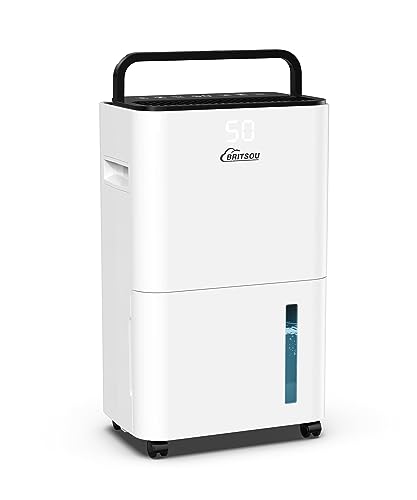
Best Balanced Pick – 34-Pint Basement Dehumidifier
If you want a practical option among dehumidifiers for basements, this 34-pint model combines adjustable humidity control, a drain hose, and a compact rolling design. It is suited to typical basements and other residential spaces where straightforward, unattended moisture control matters.
Best For: Typical basements, bedrooms, bathrooms, laundry rooms, and garages up to about 2,000 square feet.
Pros:
- Removes up to 34 pints of moisture per day and supports humidity settings from 30% to 80%.
- Includes a 6.56-foot drain hose for continuous drainage, plus a 0.66-gallon tank with automatic shutoff.
- Offers rolling casters, a child lock, a 24-hour timer, and stated operation at 41 dB or less.
Cons:
- Its stated coverage is smaller than the 4,500- to 5,000-square-foot claims of the larger models in this roundup.
- The 0.66-gallon tank may require more frequent emptying when continuous drainage is not available.
This is a sensible choice for everyday basement humidity rather than unusually large or severe moisture loads. The hose connection and automatic restart help make it convenient for routine unattended use.
Best for Large Spaces – 80-Pint Energy Star Dehumidifier
For larger areas, this 80-pint unit is one of the more capable dehumidifiers for basements in the group. Its advertised 5,000-square-foot coverage, Energy Star certification, and continuous-drain option are geared toward extended operation in sizable spaces.
Best For: Large basements, garages, and other rooms or homes up to a stated 5,000 square feet.
Pros:
- Rated to remove up to 80 pints of moisture per day under the stated test conditions.
- Offers adjustable humidity control from 30% to 80% and an Energy Star certified design.
- Includes a 1.72-gallon tank and drain-hose connection for continuous operation.
- Listed features include sleep, fan, and dry modes, a 24-hour timer, child lock, and 35 dB operation.
Cons:
- The larger capacity and 13.5 kg weight may be less convenient to move than a compact model.
- Its advertised 80-pint capacity is based on specific high-temperature, high-humidity test conditions.
This model makes the most sense when a smaller basement unit may struggle to keep up. Continuous drainage can also reduce maintenance during long operating periods, provided a suitable drain setup is available.
Best Pumped Drainage – avylo 90-Pint Basement Dehumidifier
This avylo model stands out among dehumidifiers for basements because it combines high moisture-removal capacity with a built-in pump. Its three drainage options and included 15-foot hose are particularly useful when a basement drain is not conveniently positioned for simple gravity drainage.
Best For: Large basements and areas up to about 5,000 square feet where pumped or long-distance drainage is useful.
Pros:
- Rated for up to 90 pints of daily dehumidification and spaces up to 5,000 square feet.
- Built-in pump provides a 15-foot lift, and the included hose supports continuous drainage.
- Offers a 2.11-gallon top-mounted tank, automatic shutoff, humidity and temperature display, and a 24-hour timer.
- Lists ENERGY STAR Most Efficient 2025 certification, child lock, and multiple safety protections.
Cons:
- At 38.6 pounds, it is substantially heavier than the smaller unit in this roundup.
- The floor drain pipe is not included, so the final drainage setup may require additional equipment.
- The 90-pint rating is specified for 90°F and 90% relative humidity conditions.
If drainage is the main challenge in your basement, the built-in pump is this model’s strongest advantage. It costs more in size and weight, but the higher capacity and long hose make it well suited to demanding, unattended operation.
Best Large-Capacity Pick – 4500 Sq. Ft. Energy Star Basement Dehumidifier
For shoppers comparing dehumidifiers for basements, this large-capacity model is designed for expansive spaces up to 4,500 square feet. Its adjustable 45–80-pint output, smart humidity sensing, quiet operation, and flexible drainage make it suited to demanding moisture-control jobs.
Best For: Large basements, whole-home areas, garages, and other spaces with access to a floor drain.
Pros:
- Handles spaces up to 4,500 square feet with adjustable 45–80-pint dehumidification.
- ENERGY STAR certified and includes a 24-hour programmable timer.
- Offers smart humidity control, auto-defrost, and five operating modes.
- Supports either tank emptying or continuous gravity drainage with the included hose.
Cons:
- Its large capacity may be more than needed for smaller rooms.
- Continuous drainage requires suitable floor-drain placement.
Choose this unit when basement coverage and unattended drainage matter more than compact size. The 40dB sleep mode and safety features add flexibility for use near living areas.
Best Energy-Efficient Compact Pick – Waykar 34-Pint Basement Dehumidifier
This Waykar is a practical choice among dehumidifiers for basements when you need coverage for up to 2,000 square feet without a particularly large unit. It combines 34-pint daily moisture removal with efficient operation, quiet performance, and two drainage methods.
Best For: Medium-size basements, bedrooms, offices, and buyers prioritizing energy efficiency and portability.
Pros:
- Removes up to 34 pints per day and covers spaces up to 2,000 square feet.
- 2025 ENERGY STAR Most Efficient certification and 190-watt power rating.
- Runs as quietly as 38dB and offers two fan speeds.
- Includes a 0.62-gallon tank, drain hose, washable filter, and memory restart.
Cons:
- The smaller tank may require frequent emptying when using manual drainage.
- Its coverage is less suited to very large basements than 4,500-square-foot models.
This model fits shoppers who want efficient, quieter basement moisture control in a moderate-size space. Its portable design and automatic safety functions make routine operation straightforward.
Best Targeted-Drying Pick – 4500 Sq. Ft. Basement Dehumidifier
For large damp areas, this is one of the more versatile dehumidifiers for basements, covering up to 4,500 square feet while letting you direct airflow toward problem spots. Its 90-degree adjustable outlet, quiet operation, and continuous-drain option are useful for basements, garages, laundry rooms, and gyms.
Best For: Large, high-humidity spaces where targeted airflow and long-running drainage are important.
Pros:
- Provides 45–80-pint dehumidification across spaces up to 4,500 square feet.
- 90-degree adjustable air outlet helps direct dry air toward corners or laundry.
- Operates at approximately 40dB with a dedicated sleep mode.
- Offers a 1.72-gallon tank, included drain hose, swivel wheels, and washable filter.
Cons:
- The larger footprint may be less convenient in tight rooms.
- Continuous drainage requires an appropriate drain location and setup.
This unit stands out when airflow direction is as important as overall capacity. Its 90-degree outlet and larger tank offer practical flexibility, while auto-defrost and overload protection support regular use in damp areas.
How We Picked the Best Dehumidifiers for Basements
We focused on the features that matter most below ground level: stated coverage area, moisture-removal capacity, drainage options, energy efficiency, controls, and ease of maintenance. Because basement conditions vary considerably, this list includes compact-capacity choices for smaller areas as well as high-output units rated for large or especially damp spaces.
Coverage ratings are useful for comparison, but they are not guarantees. A cool, divided, or heavily humid basement may require more capacity than a similarly sized finished room.
Quick Comparison
| What to Compare | Best Match |
|---|---|
| Smaller basement or limited moisture | Approximately 30–35-pint models |
| Large or persistently damp basement | 80–90-pint models |
| Hands-off drainage | A unit with a pump or accessible continuous-drain hose |
| Lower operating costs | An Energy Star or highly efficient model |
| Flexible daily use | Automatic humidity control, timer, and multiple modes |
Key Buying Factors for Dehumidifiers for Basements
Capacity and Coverage
Choose capacity according to both floor area and moisture level. A moderately damp basement may work well with a 30- to 35-pint unit, while a large, humid, or visibly wet space generally benefits from an 80-pint or higher-capacity model. If the basement is divided into rooms, airflow may be limited even when the published coverage seems adequate.
Drainage and Pump Options
Water tanks require frequent emptying, which can be inconvenient in a basement. Continuous-drain models use a hose to send water to a floor drain or sump area. A built-in pump is more versatile when the drain is higher than the appliance, but confirm that the hose, pump lift, and outlet location suit your setup.
Humidity Controls and Operation
Look for an adjustable humidistat so the unit can maintain a target humidity instead of running constantly. Auto-restart is useful after power interruptions, while timer, sleep, and laundry modes can make daily operation easier. Wheels and handles matter if you plan to move the appliance between areas.
Efficiency, Noise, and Maintenance
Energy-efficient operation can reduce long-term running costs, especially when the unit operates for much of the year. Check noise expectations before placing a model near a finished living area. Clean the filter as recommended, keep air inlets clear, and leave adequate space around the exhaust for reliable performance.
Who Should Buy Which Dehumidifiers for Basements?
Choose a Smaller-Capacity Model If:
Your basement is relatively dry, compact, or used occasionally. A 30- to 35-pint unit may provide a practical balance of size, cost, and moisture control.
Choose a High-Capacity Model If:
The basement is large, noticeably damp, musty, or prone to condensation. An 80- or 90-pint model can remove moisture faster and may reduce the need for continuous operation.
Choose a Pump-Equipped Model If:
You do not have a nearby floor drain or the drainage point sits above the dehumidifier. A pump can simplify installation, but measure the required vertical distance before buying.
Choose an Efficient Smart-Control Model If:
You expect frequent or year-round use and want the appliance to regulate humidity automatically. Prioritize a reliable humidistat, auto-restart, continuous drainage, and accessible replacement filters over extra modes you may not use.