The right silverware can make everyday meals more manageable when tremors, arthritis, reduced strength, or limited hand control affect how you eat. This roundup compares 10 ergonomic adaptive utensils, including lightweight foam-grip sets, weighted designs, angled handles, and adjustable options.
Use the guide below to match utensil weight, handle shape, adjustability, and portability to the user’s specific needs—not just the product’s marketing label.
Best 10 Ergonomic Adaptive Utensils Picks for 2026
Best Portable Pick
BUNMO Foam-Grip Adaptive Utensils

- Soft, lightweight, non-slip foam handles
- Four-piece set with rocker knife
- Includes reusable canvas travel wrap
Best For: Portable everyday dining support for seniors and adults
Best Customizable Grip
Bendable 4-Piece Adaptive Utensils

- Adjustable fork and spoon angles
- Wide, palm-supporting handles
- Designed for right- or left-handed users
Best For: Users who need personalized utensil positioning
Best Simple Everyday Set
Vive Ribbed-Handle Adaptive Utensils

- Wide ribbed composite handles
- Includes fork, spoon, and knife
- Dishwasher safe with 60-day guarantee
Best For: Daily meals requiring a secure, non-slip grip
Best Weighted Adjustable Set
Holotap 270-Degree Adaptive Utensils

- Weighted handles add stability
- 270-degree adjustable metal design
- Includes enlarged spoon and four total pieces
Best For: Users with tremors or limited grip seeking added control
Customizable Grip Aid
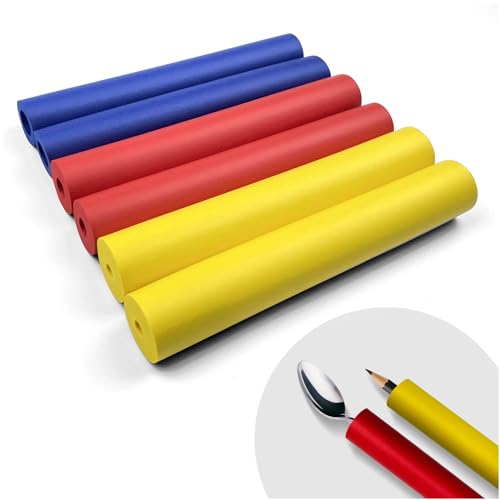
- Six 8-inch tubes in three inner diameters
- Cut-to-fit design for utensils and tools
- Non-slip, water-resistant surface
Best For: Customizing grips for multiple daily-use items
Tremor-Control Flatware
Angled Weighted Adaptive Utensils

- 42-degree angled utensil design
- 2.5-ounce weighting for added stability
- Large non-slip silicone handles
Best For: Right-handed users with tremors or limited dexterity
Compact Grip Collection
Eight-Pack Foam Utensil Tubing

- Eight grips in four inner-diameter sizes
- Compact 3.54-inch tube length
- Water-resistant, non-slip coating
Best For: Adapting multiple compact household handles
Best Angled Grip
Purple Right-Handed Spoon and Fork

- Angled design helps limit wrist rotation
- Weighted, textured silicone handles
- Dishwasher-safe two-piece set
Best For: Right-handed users needing basic tremor-support utensils
Best Complete Dining Kit
9-Piece Angled Adaptive Utensils Set

- Includes utensils, dishware, mats, and travel wrap
- 45-degree angled weighted silverware
- Dishwasher-safe stainless steel and silicone
Best For: Users wanting a complete home or travel mealtime setup
Best Compact Four-Piece Set
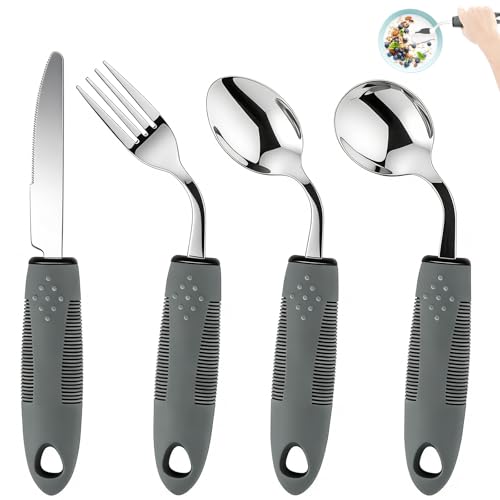
- 45-degree angle minimizes wrist movement
- Weighted, textured oversized handles
- Dishwasher-safe stainless steel construction
Best For: Right-handed users seeking a focused four-piece assistive set
Best Portable Pick – BUNMO Foam-Grip Adaptive Utensils
For shoppers comparing ergonomic adaptive utensils, the BUNMO set combines soft, lightweight foam handles with a practical travel wrap. It includes four everyday pieces, including a rocker knife designed to cut without a sawing motion.
Best For: Seniors and adults who want a lightweight, comfortable set for daily meals at home or while dining out.
Pros:
- Soft, cushioned, non-slip foam handles help reduce hand strain.
- Four-piece set includes a fork, tablespoon, teaspoon, and curved rocker knife.
- Reusable canvas wrap keeps the utensils organized for travel.
- Rust-resistant stainless steel and dishwasher-safe construction support daily use.
Cons:
- Foam handles may not suit shoppers who prefer weighted utensils.
- The set includes one knife and does not include specialized pieces beyond the listed four.
The BUNMO set is a strong choice when portability and a lightweight grip matter most. Its included wrap makes it especially convenient for restaurants, gatherings, or caregivers helping users maintain an independent routine.
Best Customizable Grip – Bendable 4-Piece Adaptive Utensils
These ergonomic adaptive utensils stand out for their bendable design, allowing the fork, tablespoon, and teaspoon to be positioned to match the user’s preferred angle. The wide grips and palm-aligned ribs are intended to support users with arthritis, tremors, Parkinson’s, or reduced grip strength.
Best For: Right- or left-handed users who need adjustable positioning and a broad handle for better control.
Pros:
- Fork, tablespoon, and teaspoon can be bent to a preferred position.
- Wide grip handles and palm-aligning ribs support dexterity and control.
- Usable by both right- and left-handed diners.
- Dishwasher safe up to 125 degrees.
Cons:
- The knife is not described as bendable like the other three utensils.
- The supplied notes do not specify a travel case or included storage wrap.
This set is worth considering when fit and angle adjustment are more important than portability. Its reversible design gives users more flexibility than fixed-handle adaptive silverware.
Best Simple Everyday Set – Vive Ribbed-Handle Adaptive Utensils
For a straightforward introduction to ergonomic adaptive utensils, the Vive set provides three essential pieces with built-up, ribbed composite handles. The non-slip texture is designed to improve control for users managing tremors, arthritis, Parkinson’s, or other dexterity concerns.
Best For: Everyday meals for users who want a compact fork, spoon, and knife set with a secure textured grip.
Pros:
- Wide, contoured ribbed handles provide a comfortable, non-slip grip.
- Three-piece set covers the basic fork, spoon, and knife.
- Premium stainless steel tips are designed for durability.
- Dishwasher safe for convenient cleanup and backed by a 60-day guarantee.
Cons:
- It has three pieces rather than the four included with some competing sets.
- The handles are non-weighted, so it may not be the right fit for shoppers seeking added utensil weight.
The Vive set keeps the design practical and uncomplicated. Choose it if a textured, built-up handle and basic place setting are enough for daily dining, without needing bendable components or a travel wrap.
Best Weighted Adjustable Set – Holotap 270-Degree Adaptive Utensils
These ergonomic adaptive utensils pair weighted handles with a 270-degree adjustable design, giving users the option to change the utensil angle while adding stability. The four-piece set also includes an enlarged spoon and built-up non-slip handles.
Best For: Adults with hand tremors, limited grip strength, or reduced hand control who may benefit from weighted and adjustable utensils.
Pros:
- Weighted handles can provide added stability for users with tremors or weak grip.
- Metal utensils bend up to 270 degrees for customized positioning.
- Four-piece set includes a fork, knife, tablespoon, and enlarged teaspoon.
- Rust-resistant stainless steel construction is dishwasher safe.
Cons:
- Weighted handles may feel less suitable for users who prefer very lightweight utensils.
- The supplied details do not mention a storage case or travel wrap.
- Adjustability may require setup to find the most comfortable angle.
Holotap is the most feature-focused option in this group for shoppers seeking both weight and adjustability. It makes sense for users who need more stability than a lightweight foam or non-weighted handle can provide.
Customizable Grip Aid – Multi-Size Foam Grip Tubing
For shoppers comparing ergonomic adaptive utensils and grip aids, this tubing offers a flexible way to enlarge handles on everyday items. The six 8-inch tubes come in three inner diameters and can be trimmed to fit utensils, pens, toothbrushes, and other tools.
Best For: People who need customizable, built-up grips for utensils and daily living tools, including users with arthritis, tremors, neuropathy, or limited grip strength.
Pros:
- Three inner-diameter options help accommodate different handle sizes.
- Can be cut to a preferred length with kitchen scissors or a knife.
- Non-slip, water-resistant coating supports secure handling and easier cleaning.
- Six 8-inch tubes provide material for multiple household items.
Cons:
- This is grip tubing rather than a complete utensil set.
- Users must measure handles and customize the tubing themselves.
- The 1.18-inch outer diameter may feel bulky for some users.
This is a practical choice when one fixed utensil design will not suit every task. Its multiple sizes and cut-to-fit construction make it particularly useful for adapting several items around the home.
Tremor-Control Flatware – Angled Weighted Adaptive Utensils
Among ergonomic adaptive utensils, this four-piece set is designed to make eating easier for users who benefit from reduced wrist rotation and added stability. Its 42-degree angled heads, 2.5-ounce weighting, and large silicone handles target tremors, limited dexterity, and hand fatigue.
Best For: Right-handed adults with Parkinson’s, hand tremors, arthritis, or limited hand mobility who want a complete adaptive eating set.
Pros:
- 42-degree angled design may reduce wrist rotation during meals.
- 2.5-ounce weighting provides added stability for hand tremors.
- Large textured silicone handles support grip and control.
- Set includes a fork, knife, and soup spoon, with dishwasher-safe stainless steel eating surfaces.
Cons:
- This version is specified for right-handed users.
- Added weight may not suit users who fatigue easily.
- The set includes three utensil types, although it is described as a four-piece set.
This set is the most purpose-built option in the group for assisted eating. The angled construction and moderate weighting may help users who want a ready-to-use solution rather than customizable tubing.
Compact Grip Collection – Eight-Pack Foam Utensil Tubing
This eight-pack is a compact option for adapting handles when shopping for ergonomic adaptive utensils or household grip aids. It includes four inner-diameter sizes, and the shorter foam tubes are intended for utensils, tools, pens, and other items that need a built-up surface.
Best For: Users who want several pre-sized foam grips for household items, rehabilitation settings, or daily tasks affected by reduced grip strength.
Pros:
- Eight grips in four sizes offer flexibility for different handles.
- Short 3.54-inch tubes can fit compact utensils and tools.
- Foam construction creates a built-up grip for improved control.
- Non-slip, water-resistant coating supports daily use and cleaning.
Cons:
- The shorter length may provide less coverage than longer tubing.
- Users should check the listed inner diameters before ordering.
- It is a grip accessory, not a complete set of eating utensils.
This pack suits shoppers who prioritize variety and compact sizing. The four diameter choices make it easier to match different handles, provided the measurements work for the items being adapted.
Best Angled Grip – Purple Right-Handed Spoon and Fork
This compact two-piece set is a practical entry point for shoppers comparing ergonomic adaptive utensils. Its angled design, moderate weighting, and textured silicone handles are intended to make eating easier for right-handed users with limited wrist movement or hand tremors.
Best For: Right-handed adults who want an angled spoon-and-fork set for Parkinson’s, hand tremors, or reduced wrist flexibility.
Pros:
- Angled spoon and fork can reduce the need to bend or rotate the wrist.
- Weighted construction is designed to add stability without excessive heaviness.
- Textured silicone handles provide a non-slip, palm-friendly grip.
- Dishwasher-safe and available in several bright colors.
Cons:
- This set includes only one spoon and one fork.
- The purple version is specified for right-handed use; left-handed shoppers need the corresponding option.
Choose this set if you need the basics rather than a complete place setting. The combination of a defined bend and grippy handle makes it a focused option for supported independent eating.
Best Complete Dining Kit – 9-Piece Angled Adaptive Utensils Set
For shoppers seeking ergonomic adaptive utensils plus mealtime accessories, this nine-piece collection is the most comprehensive option here. It combines 45-degree angled, weighted silverware with a plate, bowl, suction mats, and a canvas travel wrap.
Best For: Seniors, care settings, and people in stroke recovery or with Parkinson’s, arthritis, or weak hand grip who need a broader dining setup.
Pros:
- Includes soup and dinner spoons, a fork, rocker knife, and serrated dinner knife.
- 45-degree angled spoon and fork designs are intended to ease wrist strain.
- Approximately 2.5–2.9-ounce weighting supports steadier handling.
- Plate, bowl, suction mats, and travel storage wrap add practical versatility.
Cons:
- It is specified for right-handed use.
- The larger kit may be more than needed if only a spoon and fork are required.
This is the strongest choice when stability tools and tableware matter as much as the utensils themselves. Its included storage wrap also makes it more convenient for travel or assisted-living use.
Best Compact Four-Piece Set – 45-Degree Weighted Silverware
This four-piece set offers a middle ground for shoppers comparing ergonomic adaptive utensils: more coverage than a basic spoon-and-fork pair, without the extra dishware in a complete kit. The 45-degree angle, approximately 2.5–2.9-ounce weight, and oversized silicone handles target steadier, lower-effort eating.
Best For: Right-handed users with Parkinson’s, arthritis, hand tremors, weak grip, or stroke-recovery needs who want a compact utensil set.
Pros:
- 45-degree angled spoon and fork design is intended to minimize wrist movement.
- Weighted construction provides stability while aiming to avoid unnecessary fatigue.
- Oversized textured silicone handles improve traction and control.
- Rust-resistant stainless steel and dishwasher-safe care simplify cleanup.
Cons:
- The set is specified for right-handed use.
- Supplied details do not identify every utensil included in the four-piece package.
This set is a sensible choice when you want the core adaptive design in a relatively focused package. It emphasizes grip and stability while retaining easy dishwasher cleanup.
How We Picked the Best Ergonomic Adaptive Utensils
We focused on features that can make self-feeding easier and more comfortable: nonslip or built-up handles, balanced weight, angled heads, adjustability, utensil variety, and practical storage. We also considered whether each set is better suited to tremors, arthritis, weak grip strength, limited wrist movement, or everyday travel.
Because hand control and comfort vary widely, no single design is best for everyone. Product descriptions should be checked for exact dimensions, materials, cleaning instructions, and weight before purchase.
Quick Comparison
| Design | Best For | What to Look For |
|---|---|---|
| Foam-grip tubing | Weak or painful grips | Diameter, softness, washable construction |
| Weighted utensils | Some hand tremors | Comfortable weight and balanced handle |
| Angled utensils | Limited wrist movement | Angle, left- or right-hand suitability |
| Adjustable utensils | Changing positioning needs | Secure adjustment and easy cleaning |
| Travel sets | Meals away from home | Compact case and complete utensil coverage |
Key Buying Factors for Ergonomic Adaptive Utensils
Handle Size and Grip Texture
A thick, cushioned handle generally requires less finger force than standard flatware. Foam tubing can be useful when a customized diameter is needed, while molded nonslip handles may offer a more secure hold. Make sure the handle fits comfortably without forcing the hand open.
Weight and Balance
Added weight may reduce some shaking by providing greater stability, but heavier utensils can increase fatigue for users with muscle weakness. Look for a balanced design rather than choosing the heaviest option automatically.
Angle and Adjustability
Angled heads can reduce wrist rotation and may help users bring food to the mouth with less repositioning. Adjustable models offer more flexibility, but the joint should lock firmly and remain comfortable during repeated use.
Cleaning and Durability
Check whether the utensils are dishwasher-safe and whether foam grips can be removed for cleaning. Stainless steel is typically durable, while soft coverings may eventually compress, split, or retain moisture.
Who Should Buy Which Ergonomic Adaptive Utensils?
Choose lightweight foam-grip utensils for users with weak hands, arthritis discomfort, or difficulty closing the fingers around thin handles. Weighted sets may be worth considering for mild-to-moderate tremors when the user can comfortably lift the added mass. Angled designs are a better starting point for limited wrist mobility or Parkinson’s-related movement challenges.
Adjustable sets suit households still determining the most helpful angle, while a compact travel wrap is useful for school, work, restaurants, or assisted living. If tremors are severe, grip strength is declining, or eating has become unsafe, consult an occupational therapist for individualized utensil recommendations.