Hip discomfort can make everyday movement harder, but choosing an at-home light-therapy device is not as simple as comparing wavelength numbers. Coverage, controls, and ease of positioning matter when you are treating a broad, curved area.
These eight listings include handheld cold-laser and red-light devices with different wavelength combinations and features. This roundup helps you compare their practical differences without treating marketing claims as proof of pain relief.
Best 8 Hip Pain Relief Laser Therapy Device Picks for 2026
Best for Longer Sessions
BETISBE Blue 5000mAh Laser Device

- Five 808nm and ten 650nm emitters
- Three power settings; timer up to 60 minutes
- Magnetic cover and carrying case included
Best For: Adjustable home sessions for people or pets
Best for Positioning Flexibility
18-Emitter Laser Wand with Tripod

- Four 808nm and fourteen 650nm emitters
- Tripod for hands-free positioning
- Four power modes; 5–30-minute presets
Best For: Hands-free positioning and preset sessions
Best White-Case Option

- Five 808nm and ten 650nm emitters
- Continuous or pulse modes; three power settings
- 60-minute maximum timer and case included
Best For: Configurable sessions in a white-housed device
Best Lightweight Handheld
Black 808nm/650nm Therapy Device

- Listed device weight of 0.3 pounds
- Up to five hours of stated runtime
- Adjustable stand and anti-slip grip
Best For: Lightweight handheld or stand-supported use
Best Hands-Free Option
Three-Wavelength Handheld Laser

- 660nm, 810nm, and 980nm light
- Four intensities and six timer settings
- Rechargeable with adjustable stand
Best For: Cordless, adjustable sessions for people and pets
Most Adjustable for Hip Use
Three-Wavelength Therapy Device
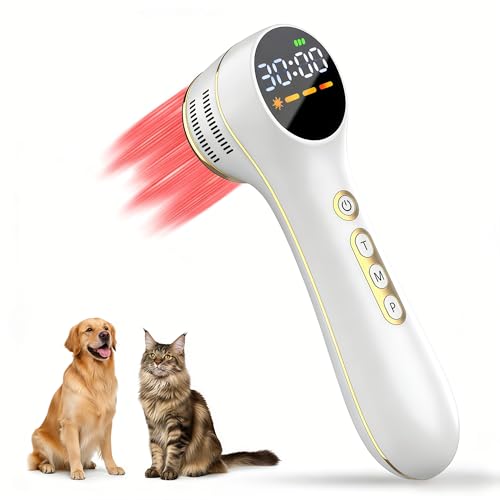
- Hip listed as a specific use
- Three power levels and two modes
- Timer up to 60 minutes; 7000mAh battery
Best For: Buyers seeking extensive controls and stated hip use
Simplest Portable Pick
Dual-Wavelength Handheld Laser

- 650nm and 808nm wavelengths
- Compact handheld design
- Few controls specified in supplied notes
Best For: Simple, portable use without extensive settings
Best Accessory Bundle

- 650nm and 808nm diodes
- Pulse and continuous modes
- Glasses, massage lens, and 5000mAh battery
Best For: Varied body-area use with included accessories
Best for Longer Sessions – BETISBE Blue 5000mAh Laser Device
If you’re comparing a hip pain relief laser therapy device for home use, this blue BETISBE model offers five 808nm and ten 650nm emitters, a 5000mAh battery, and settings you can adjust for shorter or longer sessions. It is marketed for both people and pets.
Best For: Buyers who want a rechargeable device with flexible timing for use on themselves or their pets.
Pros:
- Continuous and pulse modes with three power settings.
- Timer adjusts up to 60 minutes.
- Includes a magnetic protective cover, charging accessories, eyewear, and a carrying case.
Cons:
- The listed item weight is 2.03 pounds, so it is not the lightest option here.
- The notes do not provide independent evidence of hip-pain outcomes.
The long timer and included case make this a practical option if you value adjustable at-home sessions. Follow the manual and avoid exposing eyes to the light.
Best for Positioning Flexibility – 18-Emitter Laser Wand with Tripod
Red Light Therapy Device for Humans, (4x808nm + 14x650nm) Red Light Therapy for Body Pain Relief
Check Price On AmazonThis hip pain relief laser therapy device stands out for its included tripod, which lets you position the wand at different angles rather than holding it throughout a session. It combines four 808nm and fourteen 650nm emitters and is marketed for human and pet use.
Best For: Buyers who want an adjustable stand and a choice of preset session lengths.
Pros:
- Tripod supports hands-free positioning.
- Four power modes and six timer choices from 5 to 30 minutes.
- Instructions specify holding the treatment end about 0.4–3.15 inches from the skin.
Cons:
- The 808nm emitters are not visible while operating, which can make their operation less obvious.
- Manufacturer instructions call for protective goggles and a particular usage schedule.
Choose this one for positioning convenience and preset controls, not for a guaranteed result: the supplied notes describe intended uses but do not establish how well it relieves hip pain.
Best White-Case Option – BETISBE 5000mAh Laser Device
If you want a hip pain relief laser therapy device with a white housing, this BETISBE model pairs five 808nm and ten 650nm emitters with a 5000mAh battery. Its controls offer continuous or pulse operation, three power settings, and a timer reaching 60 minutes.
Best For: Buyers seeking the white version of a configurable device marketed for both people and pets.
Pros:
- Three power settings and continuous or pulse modes.
- Timer can be set for up to 60 minutes.
- Comes with a protective cover, charging accessories, eyewear, and a case.
Cons:
- At a listed 2.01 pounds, it is heavier than the lightweight handheld option in this roundup.
- The supplied notes do not document clinical results for hip pain.
This is a sensible pick when the included accessories and adjustable controls matter more than minimum weight. Read the instructions before use, especially if sharing it between human and pet applications.
Best Lightweight Handheld – Black 808nm/650nm Therapy Device
For buyers who would rather hold a compact hip pain relief laser therapy device, this black model has a listed device weight of 0.3 pounds and an anti-slip grip. It uses 808nm and 650nm light and also includes an adjustable stand when you want to set it down.
Best For: Buyers prioritizing a light handheld design with the option of stand-supported use.
Pros:
- Listed 0.3-pound device weight and anti-slip design.
- Rechargeable, with a stated runtime of up to five hours.
- Includes an adjustable stand and a two-press startup safeguard.
Cons:
- The supplied notes do not specify the number of 808nm or 650nm emitters.
- Details on the advertised power and timer settings are limited.
Its handling and stand are the clearest reasons to choose it. Although the listing recommends repeated 20-minute sessions, it does not provide evidence that this schedule will relieve a particular cause of hip pain.
Best Hands-Free Option – Three-Wavelength Handheld Laser
If you’re comparing a hip pain relief laser therapy device for a flexible home routine, this handheld model combines 660nm red light with 810nm and 980nm infrared wavelengths. Its adjustable stand gives you a hands-free positioning option, though you’ll still need to find a comfortable angle for the hip.
Best For: People who want cordless, adjustable light sessions for themselves or their pets.
Pros:
- Four intensity levels, continuous or 30Hz pulse mode, and six timer settings.
- Rechargeable, portable design with an adjustable stand.
- Includes protective glasses, charging accessories, and a user manual.
Cons:
- The supplied notes do not specify battery runtime.
- Hip-specific use or outcomes are not documented in the supplied notes.
This is a practical pick if positioning and session controls matter most. Its wavelength options add flexibility, but the product details do not establish how well it relieves hip pain.
Most Adjustable for Hip Use – Three-Wavelength Therapy Device
This hip pain relief laser therapy device explicitly lists the hip as an intended use. It pairs 650nm, 808nm, and 980nm wavelengths with three power levels, pulse and continuous modes, and a timer adjustable up to 60 minutes.
Best For: Buyers who want a hip-listed device with extensive session controls for people or pets.
Pros:
- Hip is listed among the product’s specific uses.
- Three wavelengths, three power levels, and pulse or continuous operation.
- 7000mAh battery, LCD screen, and detachable magnetic head cover.
Cons:
- At 2.33 pounds, it is heavier than some other handheld options listed here.
- The supplied notes do not provide independent evidence for the claimed pain-relief results.
Its main advantage is control over session settings, not a demonstrated clinical outcome. Consider it if those adjustments and the stated hip use outweigh the added weight for you.
Simplest Portable Pick – Dual-Wavelength Handheld Laser
If you want a straightforward hip pain relief laser therapy device rather than a long list of controls, this handheld unit offers 650nm and 808nm wavelengths. The supplied instructions describe simple use: point it about an inch above the skin.
Best For: Buyers who prioritize basic operation and portability over adjustable settings.
Pros:
- Dual 650nm and 808nm wavelengths.
- Compact handheld design intended for use on the go.
- Simple positioning instructions in the supplied notes.
Cons:
- The supplied notes do not list power levels, pulse modes, or timer settings.
- Hip-specific use and results are not documented.
This is the uncomplicated option in the lineup. Check whether its limited published specifications meet your needs before choosing it for a hip-focused routine.
Best Accessory Bundle – Dual-Wavelength USB Edition
This hip pain relief laser therapy device combines 650nm and 808nm diodes with pulse and continuous modes. It is described for face and body use by people and pets, and its accessory set includes protective glasses and a massage lens.
Best For: Buyers who want a dual-wavelength device with included accessories for varied body-area use.
Pros:
- Five 808nm and ten 650nm diodes, according to the supplied notes.
- Pulse and continuous modes with a color LCD screen.
- 5000mAh battery, protective glasses, massage lens, and stated two-year warranty.
Cons:
- Timer settings and individual power controls are not specified in the supplied notes.
- Hip-specific results are not documented.
The included accessories distinguish this model, while its published controls are less detailed than those of some alternatives. Confirm the settings you need before purchasing it specifically for hip use.
How We Picked the Best Hip Pain Relief Laser Therapy Device
We focused on the features stated in the selected listings: advertised wavelengths, handheld design, power and timer controls, pulse mode, and intended human or pet use. Those details help narrow down an at-home Hip Pain Relief Laser Therapy Device, but they do not establish clinical effectiveness. We did not treat a larger diode count, battery-capacity claim, or the phrase “cold laser” as proof that one device delivers better results. Two selected listings have the same product name; check whether they represent different sellers or configurations before comparing prices.
Quick Comparison
Start with how you plan to use the device. The 650 nm and 808 nm combination appears across several listings; one advertises four 808 nm and fourteen 650 nm emitters, while another advertises five 808 nm and ten 650 nm emitters with a 5000 mAh battery. A black handheld option lists three power modes and four timer settings. Another highlights pulse mode, three power levels, and a timer of up to 60 minutes. The white handheld model emphasizes human and pet use. Treat these as listing-level differences, not a ranking by therapeutic strength: diode counts alone do not reveal delivered dose or treatment-area coverage.
Key Buying Factors for a Hip Pain Relief Laser Therapy Device
Coverage and Positioning
The hip area is larger than a knee or wrist. Check the treatment-head size and whether you can hold it comfortably against the outer hip or surrounding muscles for the recommended session. A small head may require several placements. Light applied to the skin should not be assumed to reach a deep hip joint.
Specifications and Controls
Confirm the exact wavelengths and whether the listing identifies the light sources as lasers or LEDs. Wavelength alone cannot tell you the delivered dose: look for clear output, treatment-time, and usage instructions. Adjustable power and timers can make sessions easier to manage; pulse mode is a preference feature unless the manufacturer provides meaningful guidance for its use.
Safety and Ownership
Read the manual for eye-protection requirements and contraindications, and never aim a laser at anyone’s eyes. Check charging method, battery-life details, warranty, return policy, and replacement support. If hip pain is severe, follows an injury, worsens, or persists, seek medical advice rather than relying on a device to diagnose or treat its cause.
Who Should Buy Which Hip Pain Relief Laser Therapy Device?
Choose a model with several timer and power settings if you value straightforward session control. Consider the pulse-mode listing if that option and its longer stated timer fit your routine. A 5000 mAh listing may suit cordless use, but verify actual runtime and whether the duplicate listings differ before buying. For shared human-and-pet use, consider only models explicitly labeled for both and follow species-specific instructions. If you want a device specifically for deep hip-joint pain, ask a clinician whether at-home light therapy is appropriate before purchasing.