Choosing the right walker matters when hallways, bathrooms, and door frames leave little room to spare. The best upright walkers for narrow doorways combine a slimmer footprint with steady support, making daily movement feel easier and more confident.
Below, we focus on compact, practical options that are easier to maneuver in tight spaces without giving up stability, comfort, or useful features like folding frames and storage.
Best 10 Upright Walkers for Narrow Doorways Picks for 2026
Compact Upright Rollator
Aliseniors 24-inch Rollator with Seat

- 24-inch width for narrower doorways
- 19.6 lb lightweight aluminum frame
- Dual brakes and 8-inch all-terrain wheels
Best For: Users who want an upright rollator for tight indoor spaces
Adjustable Rehab Walker
Heavy-Duty Adjustable Upright Walker

- Width adjusts from 16.9 to 38.6 inches
- 6-point stability system with anti-recline support
- Stainless steel frame with dual brakes
Best For: Users who need a customizable stability-focused rehab walker
Heavy-Duty Narrow Walker
450 lb Adjustable Upright Walker

- Narrowest width is 18 inches
- Supports up to 450 lbs
- One-touch folding with removable armrests
Best For: Bariatric users needing a narrow heavy-duty upright walker
Petite Narrow Rollator
NOVA GetGo Petite for Small Spaces

- 13 lb. lightweight frame
- Narrow design for tight indoor spaces
- Lock N Load folding system for transport
Best For: Petite users needing a compact rollator for narrow indoor spaces
Adjustable Narrow Walker
Folding Walker for Tight Doorways
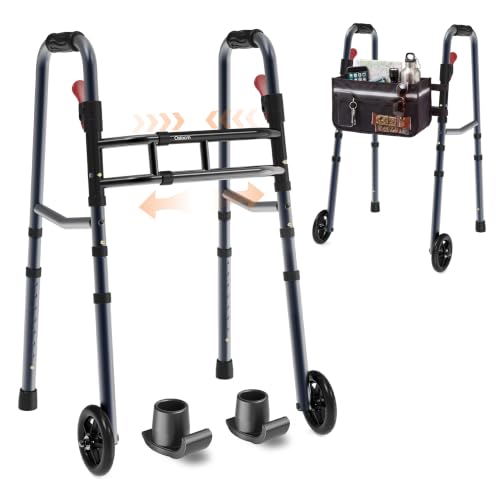
- Adjusts from 17.7" to 25.8" without tools
- Slims to fit 22.5" doorways
- 6.8 lb. frame supports up to 350 lb.
Best For: Seniors and adults who need a lightweight walker for tight doorways
Best Narrow Upright Walker
Folding Narrow Upright Walker with Forearm Support

- 18-22 inch adjustable width for tight doorways
- Forearm cradle with padded arm troughs
- 450 lb capacity with one-finger folding
Best For: seniors, bariatric users, and stroke recovery support
Best Lightweight Narrow Walker
Whlicks Folding Walker for Small Space
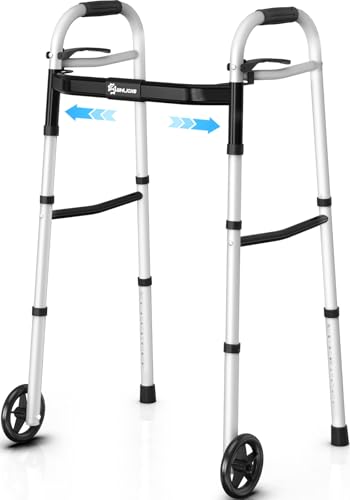
- 6.6 lb frame is easy to lift and store
- Adjustable width handles tighter home spaces
- Supports up to 350 lbs with 5-inch wheels
Best For: seniors who want a lightweight folding walker for compact rooms
Best Compact Walker with Storage

- Fits 22.5 inch doorways with width adjustment
- Anti-accidental folding button for added safety
- 6.8 lb frame with storage bag and 350 lb capacity
Best For: seniors and post-surgery users needing a narrow walker with storage
Compact Upright Rollator – Aliseniors 24-inch Rollator with Seat
If you need upright walkers for narrow doorways, this Aliseniors rollator is built around a slimmer 24-inch width and a lightweight frame, making it easier to navigate bathrooms, hallways, and other tight indoor areas. It still keeps the upright-walking posture, seat comfort, and everyday stability many shoppers want in a practical rollator.
Best For: Seniors and adults who want an upright rollator that fits through narrower indoor spaces without giving up a seat.
Pros:
- 24-inch width is narrower than a standard upright walker for easier doorway passage
- Lightweight 19.6 lb aluminum frame is easier to maneuver and transport
- 8-inch solid polyurethane wheels help with indoor and outdoor surfaces
- Dual braking system adds secure stopping and parking support
Cons:
- Seat is described as ideal for slim to medium-sized users
- Not the lightest option in the group for ultra-portable needs
- Primarily aimed at users who fit the listed height range
This is a solid pick if your priority is a narrower upright rollator that still includes a seat, storage, and folding convenience for daily use.
Adjustable Rehab Walker – Heavy-Duty Adjustable Upright Walker
For buyers comparing upright walkers for narrow doorways, this model stands out more for adjustability and stability than for an ultra-compact footprint. Its width can be set from 16.9 to 38.6 inches, which gives it flexibility for different spaces, while the six-point stability design is aimed at safer everyday mobility and rehab use.
Best For: Adults needing a highly adjustable upright walker for rehab or mobility support where stability matters most.
Pros:
- Width and height are fully adjustable for a customized fit
- 6-point stability system and anti-recline bracket support safer use
- Reinforced stainless steel frame is built for heavy-duty use
- Speed-adjustable wheels with dual brakes suit rehab and daily walking
Cons:
- Not as explicitly compact as the narrow apartment-focused options
- Heavier-duty construction may be less convenient to move and store
- Best suited to users who need support more than a lightweight frame
If you want a walker with broad adjustment and a strong safety focus, this is a practical option, but it is not the most space-saving choice for very tight doorways.
Best for Apartments – VOCIC Z32 Indoor Rollator
This VOCIC Z32 is one of the most relevant upright walkers for narrow doorways if your main goal is apartment mobility. With a maximum width of just 22 inches, it is specifically described as fitting narrow doorways, and its lightweight build plus quick-fold design make it easy to live with in smaller spaces.
Best For: Apartment users who need a compact indoor rollator for tight hallways, corners, and doorways.
Pros:
- 22-inch maximum width is designed for narrow apartments and doorways
- Weighs only 14 lbs, making it easy to carry and reposition
- Soft 8-inch PU tires are quieter than PVC tires
- Tray, mesh compartment, and pockets add useful indoor storage
Cons:
- Indoor-focused design may be less ideal for rough outdoor terrain
- Weight capacity is lower than some heavy-duty options
- Best suited to users who want a compact rollator rather than a bariatric frame
For small homes and apartments, this is the strongest space-saving choice in the group, especially if you want quiet wheels and everyday indoor convenience.
Heavy-Duty Narrow Walker – 450 lb Adjustable Upright Walker
If you want upright walkers for narrow doorways but need a higher weight capacity, this folding upright walker is built around width adjustability and heavy-duty support. Its narrowest setup is 18 inches wide, which helps it pass through tight doorways, while the removable armrests and height range make it adaptable for daily use.
Best For: Bariatric users or adults who need a narrow, heavy-duty upright walker with a high weight limit.
Pros:
- Narrowest width is 18 inches for easier passage through tight spaces
- Supports up to 450 lbs with an H-frame heavy-duty build
- 5 levels of width adjustment for better fit in different spaces
- One-touch folding and tool-free assembly support convenience
Cons:
- Very strong frame may be more than some users need
- More of a support-first walker than a lightweight compact model
- Best for users who can take advantage of the adjustable width and armrest setup
This is the best fit if doorway clearance and strength both matter, especially for users who need a narrow walker with bariatric support.
Petite Narrow Rollator – NOVA GetGo Petite for Small Spaces
If you need upright walkers for narrow doorways, the NOVA GetGo Petite is a practical pick for smaller users who want a compact frame that is easier to steer in tight indoor spaces. Its narrow design, lightweight build, and petite sizing make it especially useful around hallways, bathrooms, and other cramped areas where bulkier walkers can be hard to manage.
Best For: Petite seniors between 4’10" and 5’4" who need a narrow rollator for indoor maneuvering and occasional travel.
Pros:
- Ultra-light 13 lb. frame is easier to lift, carry, and store.
- Narrow build helps with maneuverability in tight indoor spaces.
- Lock N Load folding system secures the walker in a folded position for transport.
- 6" wheels and locking hand brakes add controlled mobility and seated safety.
Cons:
- Designed specifically for petite users, so it is not a fit for taller walkers.
- Seat size is compact at 12"W x 12"D.
Overall, this rollator stands out if your priority is a narrow, easy-to-handle walker that still includes a seat and storage. It is a strong match for home use where fit and maneuverability matter most.
Upright Comfort Walker – VOCIC Z22 GelSoft Stand Up Walker
Among upright walkers for narrow doorways, the VOCIC Z22 focuses more on comfort and stability than on the slimmest frame. Its 360-degree front wheel steering is designed to help the walker turn in narrow spaces, while the upright armrest setup and large wheels make it a solid option if you also need support on mixed indoor and outdoor surfaces.
Best For: Adults who want an upright walker with arm support, a seat, and easier steering in tight spaces.
Pros:
- GelSoft armrests are designed to reduce elbow pressure and improve comfort.
- Flip-out armrest adds extra seat width and can support a more customized fit.
- 8" wheels and front-wheel steering help with obstacles and narrow-space turning.
- Reinforced frame supports up to 300 lb. and includes height adjustments for the handle and seat.
Cons:
- Larger overall footprint may be less ideal than ultra-narrow walkers for very tight doorways.
- Requires sufficient hand grip strength and upper body mobility.
This is a good choice if you want an upright walker with seated comfort and strong stability, especially when maneuverability matters but comfort cannot be sacrificed. It is better suited to users who value support and posture than the smallest possible frame.
Adjustable Narrow Walker – Folding Walker for Tight Doorways
If your main goal is finding upright walkers for narrow doorways, this adjustable narrow walker is built around that need. It adjusts from 17.7" to 25.8" without tools and is designed to slim down enough for 22.5" doorways, making it a strong fit for small bathrooms, compact hallways, and other tight home spaces.
Best For: Seniors and adults who need a lightweight, narrow walker that can fit through tight indoor openings.
Pros:
- Width adjusts tool-free from 17.7" to 25.8" for narrow spaces.
- Slims down to fit 22.5" doorways.
- Very light at 6.8 lb. yet supports up to 350 lb.
- Folds instantly and includes a detachable storage bag.
Cons:
- Two-wheeled design is simpler than a full rollator with seat.
- Not intended for users who want upright forearm support.
This model is the most doorway-focused option in the group, especially if your space is tight and you want a walker that stays easy to fold and carry. It is a practical daily-use choice for home mobility where narrow fit is the first priority.
Best Narrow Upright Walker – Folding Narrow Upright Walker with Forearm Support
If you’re comparing upright walkers for narrow doorways, this model stands out for its adjustable 18-22 inch width and forearm-support design. It is built to fit tighter spaces while still offering a heavy-duty 450 lb capacity, making it a practical pick for users who want upright posture support in compact homes.
Best For: Seniors, bariatric users, and stroke recovery users who need a narrow upright walker with forearm support.
Pros:
- Adjustable narrow frame shrinks to 18-22 inches for tighter doorways and small rooms.
- Full forearm cradle with padded arm troughs helps reduce shoulder strain.
- Supports up to 450 lbs while still folding flat for storage and travel.
- Height adjusts from 42 to 51 inches for a wide range of users.
Cons:
- It is larger and heavier-duty than a basic standard walker.
- Best fit depends on matching the narrow width to your doorway measurements.
Overall, this is a strong choice if you want the upright-walker benefits of forearm support without giving up maneuverability in narrow spaces. Its folding design, wide height range, and high weight limit make it especially useful for home use and everyday mobility support.
Best Lightweight Narrow Walker – Whlicks Folding Walker for Small Space
When you’re shopping for upright walkers for narrow doorways, this Whlicks model is worth a close look for its adjustable width and light 6.6 lb frame. It is designed to move through narrow hallways and bathroom doors while still supporting up to 350 lbs, which makes it a practical everyday walker for smaller living spaces.
Best For: Seniors who want a lightweight folding walker with adjustable width for tighter home spaces.
Pros:
- Adjustable width from 22.4 to 26.4 inches for navigating narrow spaces.
- Very light at 6.6 lbs, making it easier to lift, store, and travel with.
- Reinforced aluminum frame supports up to 350 lbs.
- 5-inch PVC front wheels are designed for smooth indoor and outdoor movement.
Cons:
- The narrow-fit setting still requires at least 22.5 inches of doorway space.
- It is a standard walker, so it does not offer forearm support.
For buyers who need a compact walker that stays easy to handle, this one balances portability with a sturdy feel. It is a straightforward option if you want narrow-space maneuverability without moving up to a heavier upright platform design.
Best Compact Walker with Storage – Narrow Walker with Skis
If you need upright walkers for narrow doorways but also want everyday convenience, this compact walker adds a storage bag, width adjustment, and smooth-gliding front wheels. It adjusts from 17.7 to 25.8 inches and is designed to slim down to fit 22.5 inch doorways, making it a smart choice for tight bathrooms, hallways, and bedrooms.
Best For: Seniors and post-surgery users who want a narrow walker with storage and easy glide movement.
Pros:
- Width adjusts from 17.7 to 25.8 inches and fits 22.5 inch doorways.
- Anti-accidental folding button adds security during daily use.
- Lightweight 6.8 lb frame supports up to 350 lbs.
- 4 front wheels and rear ski-style glides help the walker roll smoothly.
Cons:
- It is a two-wheeled walker, so it is not a full upright platform design.
- The height range is best suited to users within the listed adjustment span.
This is a practical pick if you want a narrow walker that combines compact storage with easier rolling. The added storage bag and safety-focused folding mechanism make it especially useful for routine home mobility and light travel.
How We Picked the Best Upright Walkers for Narrow Doorways
We looked for walkers that balance a narrow frame with dependable stability, because a compact design only helps if it still feels secure in daily use. Priority went to models with adjustable width or height, folding convenience, reasonable weight, and features that support indoor mobility in tight homes.
For Upright Walkers for Narrow Doorways, the real test is not just overall width. Armrest placement, turning radius, wheel design, and how easily the frame folds or locks for transport all matter when navigating small rooms and tight hallways.
Quick Comparison: What to Look for
In a fast comparison, the best choices usually fall into a few buckets: slim walkers for the tightest interiors, adjustable models for a more customized fit, and heavier-duty options for users who need higher weight capacity. Some prioritize portability, while others focus on support and standing posture.
- Smallest footprint: Best for very narrow doorways and compact apartments.
- Adjustable frames: Useful when you need to fine-tune width, handle height, or arm support.
- Heavy-duty builds: Better for higher weight limits and added durability.
- Folding designs: Helpful for storage, travel, and moving through cramped spaces.
Key Buying Factors for Upright Walkers for Narrow Doorways
Width and Turning Clearance
Measure your narrowest doorway, hallway pinch points, and bathroom entrances before buying. A walker can fit the opening on paper but still feel awkward if the handles or wheels need extra turning space.
Height and Armrest Adjustability
Upright walkers work best when the user can stand tall without hunching. Adjustable handles or armrests help match posture, reduce strain, and improve control during indoor use.
Wheel Type and Floor Surfaces
For hardwood, tile, or low-pile carpet, smoother wheels may be easier to steer. If your home has thresholds or uneven transitions, look for tires and casters that improve traction and stability.
Weight Capacity and Frame Strength
Choose a capacity that leaves a comfortable margin above your current needs. A stronger frame can feel more secure, especially if you plan to use the walker daily.
Folding and Storage Practicality
If you need to tuck the walker beside a bed, inside a closet, or into a car trunk, folding size matters almost as much as walking width. This is especially important in smaller homes where space is limited.
Who Should Buy Which Upright Walkers for Narrow Doorways?
If you need the tightest fit for compact interiors, prioritize the slimmest models in the roundup. If posture support and comfort matter most, choose an upright design with better arm support and strong adjustability. If you need maximum durability, look for the heavier-duty narrow options. And if you plan to move the walker between rooms, store it often, or transport it in a vehicle, a lightweight folding model may be the best match.
Overall, the best Upright Walkers for Narrow Doorways are the ones that fit your home first and your body second. When both measurements line up, daily mobility becomes noticeably easier.