Cleaning tall windows is time-consuming and risky, especially when exterior glass is difficult to reach. The best window cleaning robots under $500 can reduce hands-on work by combining suction, automated path planning, spray systems, and safety backups.
This roundup compares 10 affordable models for indoor and outdoor glass, including compact robots, high-suction options, edge-cleaning designs, and units that also work on doors, tiles, and other smooth surfaces. Use the guide below to match features with your windows, cleaning routine, and budget.
Best 10 Window Cleaning Robots Under 500 Picks for 2026
Best High-Window Coverage

- 6400Pa variable suction for vertical glass
- UPS backup and safety cable for high windows
- Works on glass, mirrors, skylights, and tile walls
Best For: High or hard-to-reach windows
Best Spray Control

- Four-nozzle spray system for even moisture
- Six modes with remote control
- Up to 25 minutes of power-failure protection
Best For: Adjustable spray and remote-controlled cleaning
Compact Convenience Pick
Tosima W5 Window Cleaning Robot
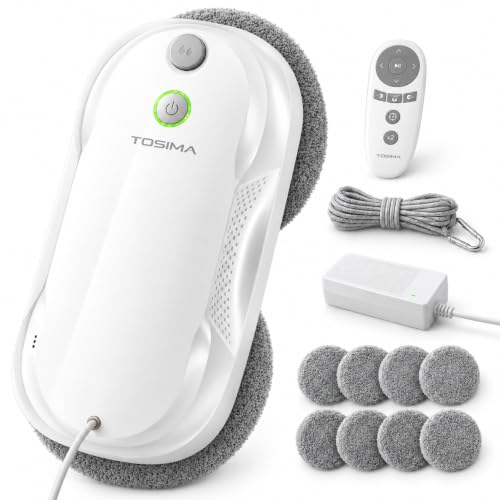
- Compact 4-pound design for easy storage
- Adaptive suction up to 6400Pa
- Triple safety system with 25-minute backup power
Best For: Apartments and smaller homes with smooth glass windows
Best for Glass-Specific Safety
Dual-Spray Edge-Detecting Robot

- 3000Pa suction with anti-drop protection
- Edge detection for frameless glass
- Includes 10 microfiber cleaning cloths
Best For: Smooth glass windows, doors, mirrors, and angled skylights
Best Compact Pick – ECOVACS WINBOT MINI
If you want window cleaning robots under 500 for routine indoor upkeep, the ECOVACS WINBOT MINI focuses on simple operation and easy handling. Its compact body, app control, ultrasonic spray, and three cleaning modes suit apartments, narrow windows, and quick touch-ups.
Best For: Apartments and light everyday cleaning on indoor glass.
Pros:
- Lightweight, compact design is easy to handle and store.
- Dual ultrasonic spray nozzles help loosen everyday dust and fingerprints.
- Strong suction and a nine-stage protection system support stable operation.
- App control and three cleaning modes simplify routine use.
Cons:
- It is optimized for light dirt; heavily soiled windows may need multiple passes.
- It uses a corded electric power source.
The WINBOT MINI is a practical entry point for shoppers who prioritize compact size, low-noise operation, and straightforward daily maintenance over heavy-duty stain removal.
Best High-Window Coverage – X6 Window Cleaning Robot
Among window cleaning robots under 500, the X6 stands out for high-window use and broad surface compatibility. Its 6400Pa variable suction, dual-spray system, edge detection, and UPS backup are designed for vertical glass, mirrors, skylights, and tile walls.
Best For: High, floor-to-ceiling, or difficult-to-reach windows where extra safety features matter.
Pros:
- 6400Pa variable suction helps maintain contact on vertical glass.
- UPS backup keeps the robot attached for up to 30 minutes during a power interruption.
- Includes a heavy-duty safety cable and anti-fall edge detection.
- Round, slim design covers up to 95% of the window area and fits narrow frames.
Cons:
- At 63 dB, it may be more noticeable than quieter compact models.
- Heavily soiled glass may require two cleaning passes and fresh pads.
The X6 is a strong choice for shoppers focused on high-window reach and safety. Its corded design still requires a suitable power connection, but the backup protection and remote operation add convenience.
Best Spray Control – TOSIMA WA9C Pro
The TOSIMA WA9C Pro is one of the more feature-focused window cleaning robots under 500, pairing four spray nozzles with remote-controlled cleaning modes. Its 2600–3200Pa suction, drop sensor, power-failure protection, and included accessories support regular glass cleaning.
Best For: Users who want adjustable spray volumes and remote control for different window-cleaning tasks.
Pros:
- Four nozzles distribute water across the glass for more even moisture coverage.
- Six intelligent cleaning modes include N-, Z-, and manual patterns.
- Power-failure protection keeps it attached for up to 25 minutes.
- Includes mops, replacement nozzles, a water bottle, and an unclogging needle kit.
Cons:
- Its battery backup is shorter than some competing models in this roundup.
- The supplied details list a 6-pound weight, which may feel less lightweight.
- A safety rope must be anchored for overhead work.
The WA9C Pro makes sense when spray adjustment and hands-on remote control are more important than the highest listed suction level. Its accessory bundle also helps support ongoing maintenance.
Best Edge Cleaning – ECOVACS WINBOT MINI 2
For shoppers comparing window cleaning robots under 500, the ECOVACS WINBOT MINI 2 is designed for narrow glass areas and cleaner edges. It combines 8000Pa suction, ultrasonic mist, corner brushes, edge detection, and five app-based cleaning modes for windows, mirrors, and glass doors.
Best For: Narrow or framed windows where edge coverage and compact navigation are priorities.
Pros:
- Compact dimensions are suited to narrow and hard-to-reach glass.
- Corner brushes and side wings guide the pad close to the frame.
- 8000Pa suction and 10-tier protection support secure movement.
- Five modes include Fast, Thorough, Deep, Spot, and Edge Clean.
Cons:
- It is intended primarily for light dirt and everyday marks; heavy grime may need repeated cycles.
- The listed noise level is 65 dB.
- Minimum applicable window dimensions may limit use on very small panes.
The MINI 2 is the better fit for buyers who dislike manual edge touch-ups. Its app control and dedicated Edge Clean mode add flexibility, while the compact form helps it work in tighter glass areas.
Compact Convenience Pick – Tosima W5 Window Cleaning Robot
For shoppers comparing window cleaning robots under 500, the Tosima W5 stands out with a compact design, adaptive suction, and automatic spraying. Its navigation and remote control make routine cleaning easier, while the backup battery and safety rope add reassurance for elevated windows.
Best For: Apartments, smaller homes, and users who want a compact robot for smooth glass surfaces.
Pros:
- Compact, lightweight 4-pound design that is easy to store.
- Adaptive suction reaches up to 6400Pa and adjusts to the surface.
- Dual-spray cleaning, intelligent navigation, and remote control.
- Triple safety system includes edge sensing, a safety rope, and up to 25 minutes of backup power.
Cons:
- Designed primarily for smooth glass windows.
- The 6-inch cleaning path may require more passes on larger windows.
The W5 is a practical choice when storage space and straightforward operation matter. Replaceable spray components and recyclable packaging are useful extras for ongoing ownership.
Value-Oriented High-Window Pick – KKI X2 Window Cleaning Robot
The KKI X2 is a value-focused option among window cleaning robots under 500, offering dual-direction spraying, automatic path planning, and remote control. It can clean smooth glass, mirrors, tiles, wooden doors, and marble, though it is best suited to light or moderate dirt.
Best For: Cost-conscious households cleaning high, smooth windows and other compatible surfaces.
Pros:
- Dual-direction auto-spray helps cover the cleaning area.
- Three cleaning modes with automatic and manual control options.
- Suitable for several smooth surfaces, including glass, mirrors, tile, and marble.
- Replaceable nozzles, microfiber cloths, and water tank covers support maintenance.
Cons:
- Requires a power connection during operation.
- Heavy dirt may require a quick pre-wipe first.
- Not intended for curved, textured, or very uneven glass; concentrated solutions may clog the sprayer.
The X2 makes the most sense for users who want automated access to high windows without relying on a ladder. Its broad surface compatibility is helpful, but the stated limitations make proper surface preparation important.
Streak-Control Pick – HOBOT-SP10 iScraper Window Cleaning Robot
For shoppers seeking window cleaning robots under 500 with a finish-focused design, the HOBOT-SP10 iScraper combines spraying, sweeping, and scraping. Its dual scrapers, edge-leakage sensors, app and remote controls, and 6000Pa suction support cleaning on framed or frameless glass, including some reclined surfaces.
Best For: Users prioritizing water removal and edge-to-edge cleaning on indoor or outdoor glass.
Pros:
- Three-step Spray-Sweep-Scrape process is designed to reduce residual water and streaks.
- Dual scrapers automatically change roles during horizontal movement.
- Edge-leakage sensors support framed and frameless glass cleaning.
- Can operate on reclined windows, greenhouse roofs, and solar panels from 7° to 100°.
Cons:
- Its 20-minute UPS backup is shorter than some competing models.
- Operation requires a corded power source, with app or remote control for operation.
The SP10 is a strong fit when water removal and edge performance are more important than the simplest possible feature set. Machine-washable cloths, replaceable scrapers and nozzles, and modular repairability may also help with long-term maintenance.
Best All-Rounder – Tosima X1 Ultrasonic Window Robot
If you are comparing window cleaning robots under 500, the Tosima X1 stands out for its dual-nozzle ultrasonic water atomization, visible 85 ml tank, and flexible control. It follows an S-shaped route, supports glass surfaces from 30×30 cm, and includes a remote for manual adjustments.
Best For: Households cleaning large and small indoor windows, including overhead sunroom glass.
Pros:
- Dual spray nozzles direct water along the cleaning path to help limit smearing.
- Large 85 ml tank has a viewing window for easy level checks.
- Strong suction, safety tether, and approximately 25 minutes of backup holding time during a power outage.
- Includes wet/dry operation, edge cleaning, low-noise design, and a two-year manufacturer warranty.
Cons:
- It is corded and must be used indoors.
- At 65 dB and 5 pounds, it is not the lightest or quietest option.
- The supplied notes do not specify a cordless cleaning runtime.
The X1 is a practical choice when tank visibility, broad window-size compatibility, and backup safety are priorities. Its remote control and manual-direction option add useful flexibility beyond automatic cleaning.
Best for Glass-Specific Safety – Dual-Spray Edge-Detecting Robot
Among window cleaning robots under 500, this model focuses on glass-specific operation, with dual spray, edge detection, intelligent path planning, and 3000Pa suction. Its 50 ml tank and included microfiber cloths support a two-pass process: dry wiping first, followed by wet cleaning.
Best For: Smooth glass windows, doors, mirrors, and skylights angled at least 30 degrees from horizontal.
Pros:
- Three cleaning paths and a pressure sensor help it detect edges, including on frameless windows.
- Triple protection combines 3000Pa suction, a four-meter safety rope, and a 15–20-minute UPS backup.
- Includes 10 cleaning cloths and dual atomizing spray nozzles.
Cons:
- It must remain plugged in; the UPS is emergency holding power, not cordless operation.
- Not recommended for curved glass, thick trim, raised decorative elements, or horizontal surfaces.
- Heavy dirt, dried stains, and other stubborn marks require manual pre-cleaning.
This robot is a sensible fit for users who prioritize edge detection and clearly defined glass compatibility. Following the recommended pre-cleaning and cloth-replacement routine should help maintain suction and cleaning results.
Best for High Suction – HCR-10 Water-Spray Window Robot
For shoppers comparing window cleaning robots under 500, the HCR-10 offers a high listed 5600Pa suction rating, automatic or manual water spraying, and three path-planning modes. It is designed for smooth surfaces such as windows, tiles, and class doors, with remote control for directional cleaning.
Best For: Smooth windows, tiles, and class doors where strong suction and multiple cleaning modes are useful.
Pros:
- 5600Pa suction and an internal drive system support steady movement.
- Automatic frame and obstacle detection helps guide its cleaning route.
- Double spiral cleaning heads and ultra-fine fiber pads are designed for deep cleaning without scratching.
- Includes a 300-pound-capacity safety rope, 10 cleaning pads, and four cleaning rings.
Cons:
- The 30 ml water container is smaller than the tanks on some competing models.
- The listed 5.7-inch cleaning path is relatively narrow.
- It is corded, and the supplied notes do not specify the conditions required for every tile or door surface.
The HCR-10 is appealing if suction power and surface versatility matter more than tank size. Its automatic and manual modes make it adaptable, while the included accessories reduce the need for immediate replacements.
How We Picked the Best Window Cleaning Robots Under 500
We focused on the features that have the greatest effect on real-world cleaning: suction strength, stability, spray coverage, navigation, edge detection, safety systems, controls, and surface compatibility. We also considered whether a robot is practical for high or exterior windows, where reliable attachment and a long safety tether matter most.
Specifications such as quoted suction pressure and cleaning modes can vary by manufacturer and surface condition. Treat them as useful comparison points rather than guarantees of identical performance on every pane.
Quick Comparison
| Feature | Why It Matters | Best For |
|---|---|---|
| Suction power | Helps maintain contact with smooth glass | Large, tall, or exterior windows |
| Dual or multi-nozzle spray | Distributes cleaning solution more evenly | Dusty or frequently cleaned glass |
| Edge detection | Helps the robot recognize borders and frames | Windows with narrow margins |
| Compact design | Fits smaller panes and tighter areas | Apartment windows and compact rooms |
| App or remote control | Makes starting, stopping, and selecting modes easier | Multi-window cleaning sessions |
Key Buying Factors for Window Cleaning Robots Under 500
Window Type and Surface Compatibility
Confirm that the robot supports your glass format before buying. Framed windows are generally easier to navigate, while frameless glass requires dependable edge detection. Some models also support smooth tiles, mirrors, or glass doors, but textured, frosted, wet, or heavily uneven surfaces may be unsuitable.
Suction, Safety, and Power Backup
Higher advertised suction can be helpful, but safe operation depends on more than the number. Look for a secure tether, automatic fall protection, low-battery alerts, and a backup power system that keeps the robot attached during an interruption. Keep the tether secured whenever the robot is used above ground level.
Spray and Cleaning Performance
Dual or ultrasonic spray systems can improve solution distribution and reduce dry passes. Check tank capacity and refill requirements if you plan to clean many panes at once. A robot still needs clean pads and suitable solution; dirty pads can spread grit and leave streaks.
Navigation and Controls
Intelligent path planning can make coverage more consistent, while multiple cleaning modes are useful for different levels of dirt. Remote controls are convenient, and app support may provide easier mode selection or status information, but neither replaces supervision.
Who Should Buy Which Window Cleaning Robots Under 500?
Choose a compact ECOVACS model if storage space is limited or your home has smaller panes. Consider a high-suction X6, Tosima W5, or similar model when stability on large or elevated windows is the priority. A spray-focused WA9C Pro or Tosima X1 may suit households that want more even solution coverage. HOBOT’s app-and-remote approach is useful for shoppers who want flexible controls and support for framed or frameless glass.
For occasional indoor cleaning, a simpler 3000Pa or 5600Pa model may offer sufficient value. For exterior, high-rise, or hard-to-reach windows, prioritize safety hardware, tether length, edge handling, and verified surface compatibility over the largest feature count. Regardless of model, supervise every session, pre-clean loose grit, and follow the manufacturer’s instructions.