Finding the right adaptive utensils can make everyday meals more comfortable and manageable for people living with hand tremors, arthritis, Parkinson’s, or reduced grip strength.
This roundup compares 10 options, including weighted, angled, bendable, built-up, and travel-friendly designs, so you can choose features that match the user’s specific needs.
Best 10 Adaptive Utensils Picks for 2026
Best Weighted Set

- Weighted, wide rubberized handles
- Curved knife for flexible cutting
- Dishwasher-safe stainless steel set
Best For: Users who prefer added weight and a curved knife
Best Bendable Design

- Bendable fork and spoons
- Right- and left-handed use
- Wide ribbed grip handles
Best For: Users who need customizable utensil angles
Best Lightweight Option
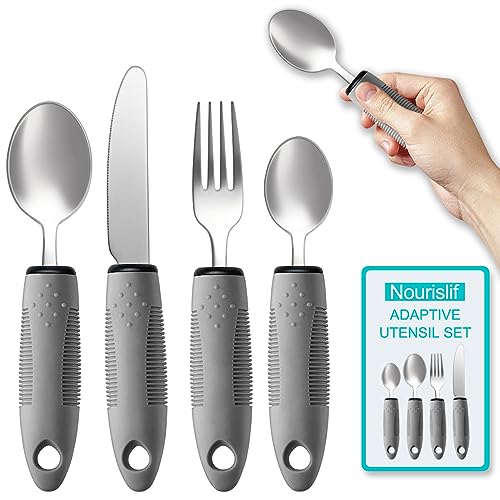
- Lightweight, enlarged handles
- Four essential dining pieces
- Dishwasher-safe stainless steel
Best For: Users who prefer non-weighted built-up handles
Best Non-Slip Grip
Special Supplies Adaptive Utensils

- Weighted utensil design
- Wide textured silicone handles
- Includes dinner and soup spoons
Best For: Users seeking weighted, non-slip control
Best Adjustable Pick
Holotap 270° Weighted Adaptive Utensils

- 270° bendable stainless steel design
- Weighted, non-slip built-up handles
- Complete four-piece dishwasher-safe set
Best For: Users needing adjustable support for tremors or limited grip strength
Best Angled Design
42° Weighted Adaptive Utensils

- Fixed 42° angle limits wrist rotation
- 2.5 oz weighted design for stability
- Large textured silicone handles
Best For: Right-handed users seeking steadier, fatigue-conscious dining
Best Simple Two-Piece Set
Bendable Spoon and Fork Adaptive Utensils

- Rotates to different angles
- Works for left- and right-handed users
- Dishwasher-safe stainless steel and rubber
Best For: Users wanting a compact, flexible spoon-and-fork set
Simple Stability Pick
Nourislif 3-Piece Weighted Adaptive Utensils

- 2.7-ounce weighted utensils
- Built-up easy-grip handles
- Dishwasher-safe stainless steel
Best For: Adults needing a basic, steady-grip utensil set
Most Complete Set
9-Piece Angled Adaptive Utensils Collection

- Nine-piece dining and travel collection
- 45-degree angled spoon and fork
- Includes bowl, plate, mats, and bag
Best For: Right-handed users wanting a complete adaptive dining kit
Angled Grip Choice
KintKita 4-Piece Weighted Utensils
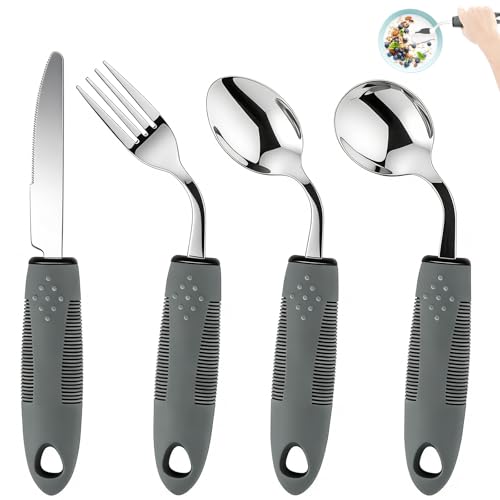
- 45-degree angled spoon and fork
- Textured oversized silicone handles
- 2.5–2.9-ounce weighted design
Best For: Right-handed users needing angled and anti-slip support
Best Weighted Set – Blue Adaptive Utensils
For shoppers comparing adaptive utensils, the BUNMO set combines weighted, wide handles with a rubberized grip to support steadier control during meals. Its four-piece configuration includes a distinctive curved knife designed for cutting from above or horizontally.
Best For: Adults who may benefit from weighted, easy-grip utensils and a curved knife, including people with hand tremors, arthritis, or Parkinson’s.
Pros:
- Includes a curved knife that supports above and horizontal cutting.
- Weighted, wide handles with molded rubber grips can improve control.
- Rust-resistant stainless steel construction is dishwasher safe.
- Includes a canvas travel wrap for portability.
Cons:
- The weighted design may not suit users seeking lightweight utensils.
- The set is limited to four pieces.
This is a practical choice when added utensil weight, a substantial grip, and the specialized knife design matter more than having a larger place setting.
Best Bendable Design – Adjustable Adaptive Utensils
These adaptive utensils stand out for their bendable design. The fork, tablespoon, and teaspoon can be positioned to suit the user, while the wide ribbed handles are shaped to support grip and control for either right- or left-handed use.
Best For: Users with arthritis, hand tremors, Parkinson’s, or reduced grip strength who want to adjust utensil angles to their preferred position.
Pros:
- Fork, tablespoon, and teaspoon can be bent into a preferred position.
- Designed for both right- and left-handed users.
- Wide handles and palm-aligned ribs support dexterity and control.
- Dishwasher safe up to 125 degrees.
Cons:
- The knife is not listed as bendable.
- The notes do not specify a weighted design.
If adjustability is your priority, this four-piece set offers more positioning flexibility than fixed-handle adaptive utensils.
Best Lightweight Option – Nourislif Built-Up Utensils
Nourislif’s adaptive utensils use enlarged, contoured handles to provide a steadier grip without a weighted design. The four-piece stainless steel set includes the everyday basics and is dishwasher safe for easier cleanup.
Best For: Adults with weak grip strength, hand tremors, arthritis, Parkinson’s, or dexterity concerns who prefer lightweight built-up handles.
Pros:
- Contoured, enlarged handles are designed for comfort and stability.
- Lightweight construction is listed as an additional feature.
- Includes a tablespoon, teaspoon, knife, and fork.
- Rust-resistant stainless steel and dishwasher-safe care simplify maintenance.
Cons:
- It is non-weighted, so it may not meet the needs of users seeking extra utensil weight.
- The set includes only four pieces.
This set makes sense for shoppers who want a straightforward, lightweight alternative with built-up handles and a one-year guarantee.
Best Non-Slip Grip – Special Supplies Adaptive Utensils
Special Supplies adaptive utensils pair a weighted design with wide, ribbed silicone handles and raised textured grips. The four-piece set covers common meals with a fork, knife, dinner spoon, and soup spoon.
Best For: Users with hand tremors, arthritis, or Parkinson’s who want weighted utensils with a pronounced non-slip grip.
Pros:
- Weighted construction may support steadier handling.
- Wide ribbed handles have raised, textured grips for control.
- Food-grade silicone handles and stainless steel utensils are dishwasher safe.
- Includes both a dinner spoon and a soup spoon.
Cons:
- The set is limited to four pieces.
- Only the listed black or gray handle colors may be available.
Choose this set when a textured silicone grip and weighted feel are more important than bendable positioning or a larger utensil collection.
Best Adjustable Pick – Holotap 270° Weighted Adaptive Utensils
For shoppers comparing adaptive utensils for tremors, arthritis, or limited grip strength, this four-piece set combines weighted handles with a highly adjustable design. Its 270-degree bendable stainless steel construction lets users change the utensil angle for a more comfortable eating position.
Best For: Adults and seniors who need adjustable, weighted silverware for hand tremors, reduced dexterity, or weaker grip strength.
Pros:
- 270-degree adjustable metal design supports customized positioning.
- Weighted, built-up non-slip handles can improve control and grip comfort.
- Includes a fork, knife, tablespoon, and enlarged teaspoon.
- Dishwasher-safe stainless steel construction is suited to daily use.
Cons:
- The set is listed as lightweight despite its weighted-handle design, so users seeking heavier utensils may want to compare weights.
- The enlarged spoon design may feel larger than standard tableware.
Overall, this is a versatile adaptive utensils set for users who value both angle adjustment and a complete four-piece place setting. The combination of weighted handles, broad grips, and larger spoons is especially practical for everyday independent dining.
Best Angled Design – 42° Weighted Adaptive Utensils
This adaptive utensils set uses a fixed 42-degree angle to reduce wrist rotation during meals. The 2.5-ounce weighting, textured silicone grips, and stainless steel construction are designed to provide steadier handling for users with tremors, arthritis, or limited hand mobility.
Best For: Right-handed seniors and adults seeking angled, moderately weighted utensils with large non-slip handles.
Pros:
- 42-degree angled design may reduce wrist movement and fatigue.
- 2.5-ounce weighting offers added stability without an excessively heavy design.
- Large textured silicone handles support grip and control.
- Dishwasher-safe stainless steel eating surfaces are suitable for regular use.
Cons:
- This listing is specifically identified as right-handed.
- The supplied notes describe a complete set but specifically list fork, knife, and soup spoon, so buyers should verify the exact contents before ordering.
Choose this option if a dedicated angled profile matters more than free adjustment. Its moderate weight and substantial silicone handles make it a focused choice for steadier, more controlled eating.
Best Simple Two-Piece Set – Bendable Spoon and Fork Adaptive Utensils
For a straightforward introduction to adaptive utensils, this two-piece set includes a bendable spoon and fork that can be rotated to suit the user’s preferred angle. Food-grade stainless steel and rubber construction, dishwasher-safe care, and ambidextrous use make it a practical option for flexible everyday dining.
Best For: Left- or right-handed users who want a compact spoon-and-fork set with adjustable positioning.
Pros:
- Flexible design can be rotated to different angles for user comfort.
- Ambidextrous format accommodates both left- and right-handed users.
- Food-grade stainless steel and rubber construction.
- Dishwasher-safe for easier cleanup.
Cons:
- Includes only one spoon and one fork, with no knife.
- The supplied notes do not specify weighted handles or a built-up grip.
- Offers fewer pieces than the four-piece adaptive utensils sets in this roundup.
This is a sensible pick when adjustability and simplicity are the priorities. Its two-piece format keeps the set compact, while the flexible, ambidextrous design can support more independent eating for users with hand-control challenges.
Simple Stability Pick – Nourislif 3-Piece Weighted Adaptive Utensils
These adaptive utensils are a straightforward option for adults who need a steadier, easier-to-hold set during meals. The built-up handles and 2.7-ounce weight are designed for users with hand tremors, arthritis, Parkinson’s, weak grip, or other dexterity challenges.
Best For: Adults seeking a basic, dishwasher-safe fork, knife, and tablespoon set with a steady grip.
Pros:
- Weighted at 2.7 ounces each to support steadier handling.
- Built-up handles provide an easier grip for limited dexterity.
- Includes a fork, knife, and tablespoon made from rustproof stainless steel.
- Dishwasher safe and backed by a one-year guarantee.
Cons:
- Only includes three utensils, without bowls, plates, or travel storage.
- Its standard design may offer less positioning support than angled utensils.
This Nourislif set keeps the focus on essential daily silverware and easy cleanup. It is a practical choice when a user primarily needs added grip and modest weight rather than a larger dining-aid collection.
Most Complete Set – 9-Piece Angled Adaptive Utensils Collection
For shoppers wanting more than silverware alone, this adaptive utensils set combines 45-degree angled utensils with mealtime accessories and a travel wrap. Its weighted, right-handed design is intended to reduce wrist strain and support more independent eating for people with tremors, arthritis, Parkinson’s, or limited hand mobility.
Best For: Right-handed users who want a complete home-and-travel dining collection with angled utensils and dish accessories.
Pros:
- Includes nine pieces: spoons, fork, rocker knife, serrated knife, plate, bowl, suction mats, and storage bag.
- 45-degree angled spoon and fork can reduce required wrist and hand movement.
- Utensils weigh approximately 2.5 to 2.9 ounces for added stability.
- Rust-resistant stainless steel heads and silicone handles are dishwasher safe.
Cons:
- Designed specifically for right-handed use.
- The larger set may be more than needed for shoppers seeking replacement utensils only.
- Its weighted design may not suit users who prefer very lightweight silverware.
This is the strongest choice for versatility in the group, especially for assisted living, travel, or post-surgery meal support. The combination of angled utensils, non-slip dishware, mats, and a portable bag makes it a more comprehensive solution than a standard utensil set.
Angled Grip Choice – KintKita 4-Piece Weighted Utensils
This KintKita set pairs 45-degree angled utensils with oversized textured silicone handles, giving users two forms of support in one compact collection. The adaptive utensils are weighted at approximately 2.5 to 2.9 ounces and are intended for right-handed users with hand tremors, arthritis, Parkinson’s, or weak grip.
Best For: Right-handed users who want angled, weighted utensils with a textured anti-slip handle.
Pros:
- 45-degree spoon and fork design helps minimize wrist and hand movement.
- Approximately 2.5 to 2.9 ounces of weight provides added stability.
- Oversized textured silicone handles improve traction and control.
- Includes four pieces and is dishwasher safe.
Cons:
- Intended for right-handed use.
- Does not include adaptive plates, bowls, mats, or a carrying case.
- Weighted handles may feel less suitable for users who need ultra-light utensils.
Compared with a basic built-up utensil set, this option adds both angled positioning and a more tactile handle. It is a focused choice for users who need help controlling the utensil itself but do not require a broader mealtime accessory kit.
How We Picked the Best Adaptive Utensils
We focused on the features most likely to affect daily usability: handle comfort, utensil weight, adjustability, angle, grip security, included pieces, portability, and overall versatility. The selected sets cover several common needs, from mild difficulty holding standard silverware to more significant challenges with wrist control or hand tremors.
Because comfort and control vary widely, no single design is best for everyone. The most useful choice is the one that reduces strain without feeling unnecessarily heavy or difficult to maneuver.
Quick Comparison
| Design | Best for | Potential advantage |
|---|---|---|
| Weighted utensils | Hand tremors and unsteady movements | Added mass may improve stability |
| Angled utensils | Limited wrist or arm mobility | Can reduce the wrist rotation needed to reach the mouth |
| Bendable utensils | Personalized positioning | Can be shaped to suit an individual grip and movement pattern |
| Built-up handles | Weak grip or arthritis | Larger surfaces are often easier to hold |
| Travel sets | Meals away from home | Storage wraps or cases improve portability |
Key Buying Factors for Adaptive Utensils
Weight and Balance
Weighted models may help dampen tremor-related movement, but extra weight can increase fatigue for users with limited strength. Consider whether the user benefits from stability or needs the lightest practical option.
Handle Shape and Grip
Look for thick, non-slip, or built-up handles when standard silverware is hard to hold. Soft or textured surfaces may offer better control, while oversized handles can be less suitable for smaller hands.
Angle and Adjustability
Angled or adjustable heads can help users with restricted wrist motion. Bendable designs provide more customization, but they should be positioned securely and checked regularly for looseness or damage.
Set Contents and Care
Check whether the set includes the pieces needed most often, such as a spoon, fork, teaspoon, tablespoon, and knife. Also verify dishwasher guidance, materials, cleaning requirements, and whether a storage case is included.
Who Should Buy Which Adaptive Utensils?
Choose weighted Adaptive Utensils when tremors are the primary concern and the user can comfortably manage additional weight. Angled models are a practical starting point for Parkinson’s-related wrist limitations or reduced range of motion. Bendable sets are better for users who need a customized utensil position, while built-up handles suit people with arthritis, weak grip, or difficulty closing the hand around thin handles.
For caregivers, families, or users who eat outside the home, a complete multi-piece set with a travel wrap can provide better day-to-day convenience. If needs are uncertain, start with a modestly weighted, non-slip set and evaluate comfort during several meals before moving to a heavier or more specialized design. A healthcare professional or occupational therapist can also help match utensil weight, angle, and handle size to the user’s motor abilities.