Adjustable slant boards can make calf stretching, squat positioning, ankle-mobility work, and rehabilitation exercises easier to perform consistently. The right design should feel stable under load while offering useful angle adjustments and enough room for your feet.
We compared 10 adjustable boards across construction, capacity, portability, comfort, and versatility to help you choose a model suited to home workouts, mobility routines, or physical therapy exercises.
Best 10 Adjustable Slant Boards Picks for 2026
Best Overall Wooden Slant Board
StrongTek Full-Coverage Adjustable Board

- Five incline settings from 15° to 35°
- Full-coverage anti-slip tread
- Hardwood construction with carry handle
Best For: Regular stretching, rehab, and mobility work
Best Heavy-Duty Slant Board
Steel 600-Pound Calf Stretcher

- Stated 600-pound weight capacity
- Five angles from 15° to 40°
- Steel frame with non-slip sandpaper surface
Best For: High-capacity stretching and rehab sessions
Best Lightweight Wooden Slant Board
StrongTek 500-Pound Adjustable Model

- Five angles from 15° to 35°
- Listed weight of 6.3 pounds
- Partial grip surface and side handle
Best For: Portable home-gym and rehab use
Best Slant Board Set
Portable Board With Resistance Bands

- Includes two bands and exercise materials
- Five angles from 23° to 45°
- Lightweight design with non-slip surfaces
Best For: Portable stretching and band-assisted workouts
Best Wide Wooden Option
StrongTek Adjustable Slant Board

- Five settings from 15° to 35°
- Wide 13-inch platform
- 350-pound capacity; folds for storage
Best For: Wide-platform stretching, squats, and mobility work
Best for High Weight Capacity
Professional Wooden Slant Board
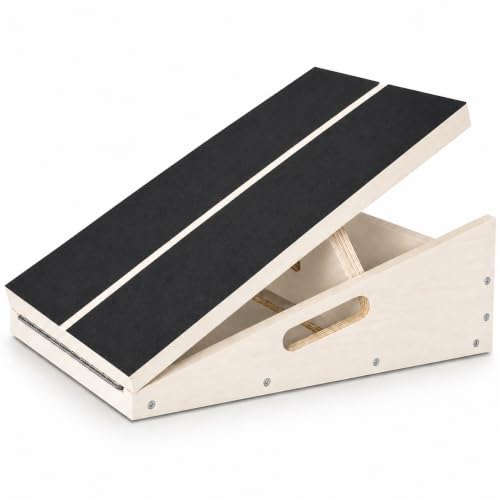
- 500-pound weight capacity
- Five settings from 15° to 35°
- Includes handles, guide, and three-year warranty
Best For: Heavy-duty stretching, mobility, and squat practice
Best Heavy-Duty Split-Platform Design

- Two independent metal platforms
- 900-pound maximum capacity
- Four levels with dual anti-slip grip
Best For: Heavy lifting, split squats, and asymmetric mobility work
Most Versatile
5-Angle Portable Wooden Slant Board

- Five incline settings from 23° to 45°
- Folds for transport and weighs 4.6 pounds
- Includes workout poster and instructions
Best For: Users seeking wide angle adjustability for stretching and mobility work
Best for Rehabilitation Routines
Portable Wooden Calf Stretch Board

- Four angle settings from 30° to 45°
- Lightweight for home, office, gym, or clinic use
- Supports stretching, squats, and posture work
Best For: Mobility and rehabilitation-focused routines with simple adjustability
Highest Capacity
TEMI Adjustable Hardwood Slant Board

- Four angles from 20° to 40°
- Stated 500-pound weight capacity
- Built-in handle and non-slip surface
Best For: Stable, high-capacity stretching, squat, and ankle-mobility training
Best Overall Wooden Slant Board – StrongTek Full-Coverage Adjustable Board
If you want adjustable slant boards for stretching, squats, or rehabilitation, this StrongTek model combines five incline settings with a full-coverage non-slip surface. Its hardwood construction and side handle make it a practical choice for regular home, office, or travel use.
Best For: Users seeking a sturdy, portable wooden board for calf and ankle stretching, recovery work, and general mobility exercises.
Pros:
- Five angles from 15° to 35° support gradual progression.
- Full-coverage anti-slip tread adds traction during use.
- Hardwood plywood construction and side handle support durability and portability.
- Arrives assembled and ready to use.
Cons:
- At 9 pounds, it is heavier than some portable alternatives.
- The listed dimensions and raised design may require more storage space.
This is a well-rounded option when stability and surface coverage matter more than minimizing weight. The five settings also make it suitable for users who want to adjust intensity over time.
Best Heavy-Duty Slant Board – Steel 600-Pound Calf Stretcher
Among adjustable slant boards, this steel calf stretcher stands out for its stated 600-pound weight capacity and five incline choices. The non-slip sandpaper surface is designed to increase friction during stretching, squats, and physical therapy exercises.
Best For: Adults who prioritize a high stated weight capacity and a sturdy steel platform for fitness or rehabilitation use.
Pros:
- Steel construction is designed to resist cracking and provide stability.
- Supports up to 600 pounds according to the supplied specifications.
- Five settings range from 15° to 40° for varied stretching intensity.
- Non-slip sandpaper surface helps improve traction.
Cons:
- The steel build may be less lightweight or convenient to carry than wooden boards.
- The orange finish may not suit every workout space.
This model is a sensible pick when load capacity and a rigid platform are the deciding factors. Its wider angle range also offers more challenge than boards that stop at 35°.
Best Lightweight Wooden Slant Board – StrongTek 500-Pound Adjustable Model
This StrongTek board offers the familiar flexibility of adjustable slant boards in a lighter wooden design. It provides five angles, a partial-coverage grip surface, and a side handle for calf stretching, squats, home-gym training, and rehabilitation.
Best For: Home users who want a portable wooden board with multiple incline levels and a lower listed weight than the full-coverage version.
Pros:
- Five adjustable positions range from 15° to 35°.
- Listed weight of 6.3 pounds makes it relatively portable.
- Lauan hardwood plywood construction supports repeated use.
- Side handle simplifies carrying and storage.
Cons:
- The partial-coverage grip surface leaves less tread coverage than the full-coverage model.
- Its angle range does not reach the 40° or 45° maximum offered by some alternatives.
This board balances portability, adjustability, and a sturdy wood build. It is especially appealing if you want a lighter carry option without giving up five incline settings.
Best Slant Board Set – Portable Board With Resistance Bands
For shoppers who want more than a standalone board, this portable set pairs adjustable slant boards with two physical therapy bands, an exercise guide poster, and an instruction manual. Its five angles run from 23° to 45°, providing a broad range for calf stretching and mobility work.
Best For: Beginners and experienced exercisers who want a lightweight stretching board with added band-based training options.
Pros:
- Includes two bands with different listed tension levels.
- Five angles from 23° to 45° offer progressive challenge.
- At about 4.5 pounds, it is convenient to carry between home, office, gym, or therapy room.
- Non-slip EVA base and PVC sandpaper surface are designed to limit sliding.
Cons:
- The supplied details list different weight capacities, so buyers should verify the applicable rating.
- Its starting angle of 23° may be less suitable for users seeking a very mild incline.
- The wooden board is smaller than some full-size options.
This is the most complete training package in the group, especially for users who want resistance-band exercises alongside calf stretching. Its low weight and 45° maximum make it versatile, but checking the weight specification before purchase is sensible.
Best Wide Wooden Option – StrongTek Adjustable Slant Board
For shoppers comparing adjustable slant boards, the StrongTek combines five incline settings from 15° to 35° with a 13-inch-wide platform. Its wooden construction, textured top, rubber base pads, and foldable carry-handle design make it suited to stretching, squats, mobility work, and compact storage.
Best For: Beginners, athletes, and rehabilitation users who want a wide, portable wooden board for calf stretching and lower-body mobility.
Pros:
- Five adjustable angles support gradual progression.
- 13-inch-wide platform allows more natural foot placement.
- Textured top and rubber bottom pads improve grip and help protect flooring.
- Supports up to 350 pounds and folds for storage.
Cons:
- Its 350-pound capacity is lower than some heavy-duty alternatives.
- Wood construction may be less suitable for shoppers specifically seeking a metal frame.
This is a practical all-around choice when platform width and portability matter. The five angles cover gentle stretching through more demanding mobility work, while the foldable design keeps it convenient for home gyms and travel.
Best for High Weight Capacity – Professional Wooden Slant Board
This professional wooden option is one of the more substantial adjustable slant boards for users who prioritize load capacity. It offers five settings from 15° to 35°, a textured standing surface, a slip-resistant base, side handles, and a visual exercise guide for stretching, squats, and ankle mobility.
Best For: Higher-weight users, home or gym training, and shoppers who want an exercise guide and a three-year manufacturer warranty.
Pros:
- 500-pound capacity provides a sturdy platform for stretching and strength work.
- Five angle settings accommodate gentler and deeper stretches.
- Textured top and slip-resistant base help support stable foot contact.
- Side carry handles, exercise guide, and three-year warranty add convenience.
Cons:
- The listed dimensions and wooden construction make it less compact than some portable designs.
- It weighs about 3.85 kg, so it may be less convenient to carry frequently.
Choose this board if a higher stated capacity and guided use are more important than minimum weight. Its five positions make it flexible for warm-ups, calf work, ankle mobility, and controlled squat practice.
Best Heavy-Duty Split-Platform Design – EXURA Wide Slant Board
The EXURA stands apart from typical adjustable slant boards with two independent metal platforms rather than one continuous surface. The design supports asymmetric foot angles, wider stances, split squats, Bulgarian split squats, and heel-elevated squat work, while four incline levels cover calf stretching and ankle mobility.
Best For: Lifters, athletes, and physical-therapy users who need independent foot positioning and an exceptionally high stated weight capacity.
Pros:
- Independent platforms allow asymmetric angles and wider stances.
- 900-pound capacity and metal construction suit heavy-duty use.
- Rubber grip tops and two base mats help keep each platform stable.
- Supports squats, split squats, calf raises, calf stretching, and foot-mobility work.
Cons:
- Four incline levels provide fewer adjustment positions than the five-level wooden boards.
- The two-platform layout may be less intuitive for users who prefer a single wide standing surface.
- Its compact footprint may offer less continuous foot support for standard two-foot stretches.
This is the specialized pick for users who want independent foot placement and maximum stated load support. Its metal frame and dual-platform layout are especially useful for strength-focused training and asymmetric mobility drills.
Most Versatile – 5-Angle Portable Wooden Slant Board
This adjustable slant board is a flexible option for calf stretching, yoga, and lower-body mobility work. Its five angle settings range from 23° to 45°, allowing users to progress from gentler stretches to more challenging positions without assembly.
Best For: Beginners and experienced exercisers who want multiple incline options in a portable wooden board.
Pros:
- Offers five angles: 23°, 30°, 35°, 40°, and 45°.
- Supports calf, glute, heel, ankle, and leg stretching.
- Folds for transport and weighs 4.6 pounds.
- Includes a workout poster and instructions.
Cons:
- The listed maximum weight recommendation is 300 pounds.
- No warranty is specified in the product details.
Choose this model if adjustability is your priority. The broad angle range and foldable design make it useful for varied routines at home or in the gym, while the compact wooden construction keeps it easy to carry.
Best for Rehabilitation Routines – Portable Wooden Calf Stretch Board
This adjustable slant board is designed for stretching, squats, and weight-bearing mobility exercises. With four positions from 30° to 45°, it provides a straightforward way to vary calf and ankle work at home, in the office, gym, or a physiotherapy setting.
Best For: Users wanting a lightweight incline board for general stretching, mobility practice, or rehabilitation-oriented routines.
Pros:
- Adjusts to four angles: 30°, 35°, 40°, and 45°.
- Lightweight design weighs about 4.5 to 5 pounds.
- Suitable for beginners, experienced athletes, and various settings.
- Can support stretching, squats, posture work, and rehabilitation training.
Cons:
- It offers fewer angle settings than some adjustable slant boards.
- The supplied details do not specify a maximum weight capacity.
- No warranty information is provided.
This is a practical pick for buyers who prefer simple, portable adjustability. Its four positions cover common stretching and squat angles, though shoppers needing a stated load rating or more granular settings may want to compare alternatives.
Highest Capacity – TEMI Adjustable Hardwood Slant Board
The TEMI is a sturdy adjustable slant board for calf stretching, squats, heel stretches, and foot-and-ankle mobility drills. Its four wedge angles—20°, 25°, 30°, and 40°—pair with a non-slip surface and a stated 500-pound capacity for users who prioritize stability and support.
Best For: Athletes, beginners, and rehabilitation users seeking a high-capacity board for mobility, balance, and squat training.
Pros:
- Provides four incline options from 20° to 40°.
- Uses a high-density hardwood construction with a 500-pound capacity.
- Includes a built-in handle and weighs about 5 pounds.
- Features a soft non-slip surface and requires no assembly.
Cons:
- Its highest listed angle is 40°, below some competing boards.
- The product details do not identify a separate workout poster or instructional guide.
- The supplied uses include broad lifestyle categories, so specific exercise guidance may be limited.
Consider this model when a stable, high-capacity platform matters more than maximum angle range. The handle, non-slip surface, hardwood build, and one-year warranty add practical appeal for regular mobility and lower-body training.
How We Picked the Best Adjustable Slant Boards
We focused on the features that matter during repeated stretching and loaded exercises: adjustment range, platform width, weight capacity, surface traction, frame stability, portability, and ease of storage. We also considered whether each board is practical for more than one use, including calf stretching, heel-elevated squats, ankle mobility, Pilates, and rehabilitation routines.
Capacity ratings are useful, but they are not the only measure of safety. A board should sit flat, resist sliding, and remain rigid at its highest angle. Wooden models can feel solid and comfortable, while steel designs may offer greater load confidence. Portable boards with handles or compact folding designs are easier to move, but wider platforms generally provide better foot placement.
Quick Comparison
| Best For | Look For |
|---|---|
| Everyday calf stretching | Several angle settings and a grippy surface |
| Heavy squats or strength work | High capacity, rigid construction, and a stable base |
| Wide or unstable feet | A platform at least 13 inches wide |
| Travel and storage | Lightweight construction, a handle, or a compact profile |
| Rehabilitation or mobility work | Small angle increments and controlled positioning |
Key Buying Factors for Adjustable Slant Boards
Angle Range and Adjustment
More settings let you start with a gentle stretch and progress gradually. A broad range around 15 to 35 degrees is useful for general mobility, while fine adjustments are preferable when recovering from an injury or following a therapist’s plan.
Stability and Weight Capacity
Choose a board rated comfortably above your body weight and the load you plan to use. Non-slip feet, a textured surface, and a rigid support mechanism help prevent movement during squats and prolonged stretches.
Platform Width and Comfort
A narrow board may be adequate for basic calf work, but a wider surface is more forgiving and can accommodate different stances. Rounded edges, a smooth finish, and dependable traction improve comfort during longer sessions.
Materials and Portability
Wood offers a familiar, sturdy feel and is often easy to carry. Steel may be better for heavier training, though it can add weight. If you store equipment in a small space, prioritize a built-in handle or a design that folds or nests compactly.
Who Should Buy Which Adjustable Slant Boards?
Choose a simple adjustable wooden board if you mainly want calf stretches, ankle mobility, or occasional squat wedges. It offers a good balance of stability, portability, and value. If you plan to perform loaded squats or want maximum rigidity, a steel or heavily reinforced model is the safer choice.
For users with larger feet or balance concerns, select a wide platform with strong traction. A model with many angle positions suits progressive stretching and physical therapy, while a compact board with a handle is best for travel or frequent storage. If your routine includes resistance-band work, a bundled band can add versatility, but verify that the board remains stable when the band is under tension.
Whichever model you choose, begin at a comfortable incline, keep movements controlled, and stop if you feel sharp pain rather than a normal stretch.