A raised doorway threshold can be a difficult obstacle for wheelchair users, walker users, and anyone with limited mobility. The right ramp creates a smoother transition while reducing the effort and risk involved in crossing doorways, curbs, and small steps.
This roundup compares 10 threshold ramps for elderly users, from compact 5/8-inch options to heavy-duty 4- and 5-inch models. Use the buying guide below to match ramp height, width, load rating, traction, and installation style to your home.
Best 10 Threshold Ramps for Elderly Picks for 2026
Heavy-Duty Rubber Access

- Wide 35.5-inch rubber design
- Beveled, grooved traction surface
- No assembly; supports up to 2,200 lb
Best For: Wide doorways and stable wheelchair or scooter access
Adjustable Aluminum Access

- Configures from 1- to 6-inch heights
- Expands to 31.5 inches wide
- Traction features and 1,100-lb capacity
Best For: Flexible access across different thresholds and wheel widths
Anchored Rubber Stability
4-Inch Heavy-Duty Threshold Ramp

- Textured, grooved, draining surface
- Mounting holes and bolts included
- Heavy rubber construction for indoor/outdoor use
Best For: Frequently used 4-inch transitions needing added stability
Simple Portable Access
3-Inch No-Assembly Rubber Ramp

- Place-and-use design requires no tools
- Non-slip surface for indoor/outdoor use
- 36 by 18 inches with 3,500-lb capacity
Best For: Quick access at home doorways, curbs, and garage entries
Best Low-Profile Pick

- 2,000-pound capacity and 35.5-inch width
- Grooved surface for wet or dry traction
- Cuttable and expandable for different openings
Best For: Low door sills and small indoor or outdoor transitions
Best Heavy-Duty Option
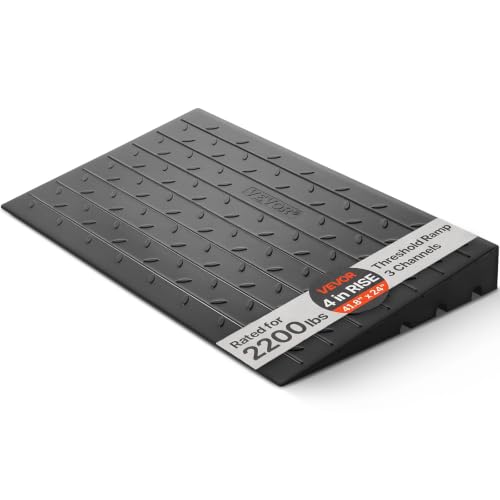
- 2,200-pound load capacity
- Three channels for cables, wires, or hoses
- Heavy 65-pound design helps resist shifting
Best For: High thresholds, curbs, garages, and assisted wheelchair access
Best for Narrow Transitions
5/8-Inch Rubber Threshold Ramp

- Low 5/8-inch rise for small door sills
- Grooved surface supports traction
- Trim or combine for a customized fit
Best For: Interior thresholds, walkers, wheelchairs, carts, and robot vacuums
Best Cut-to-Fit Option
VEVOR 1.6-Inch Cuttable Rubber Threshold Ramp

- Cuttable 35.4-inch width
- Anti-slip striped surface
- 33,069-pound stated capacity
Best For: Customizing a low-rise doorway transition
Best Heavy-Duty Wide Ramp
VEVOR 2.5-Inch Rubber Threshold Ramp

- Wide 24-inch passage surface
- Three built-in cable channels
- Supports up to 2,200 pounds
Best For: Wide, fixed transitions with cables or hoses
Best Simple Low-Profile Ramp
1.5-Inch Rubber Threshold Ramp

- No assembly required
- Anti-slip grooves aid drainage
- 2,204-pound stated capacity
Best For: Small thresholds needing a simple, low-rise transition
Heavy-Duty Rubber Access – 3" Rise Threshold Ramp
For shoppers comparing threshold ramps for elderly users, this VEVOR model offers a broad, one-piece rubber transition for doorways and uneven surfaces. Its beveled edges, grooved tread, and 2,200-pound stated capacity support wheelchairs, scooters, and other equipment.
Best For: Wide indoor or outdoor doorways needing a durable, ready-to-use 3-inch transition.
Pros:
- 35.5-inch length and 17.7-inch width accommodate wheelchairs up to 26.8 inches wide.
- Beveled edges provide smoother approaches from multiple sides.
- Grooved rubber surface is designed for traction, while the one-piece design needs no assembly.
- Rated to support up to 2,200 pounds according to the product notes.
Cons:
- At about 29 pounds, it may be cumbersome to reposition frequently.
- The rubber material may have a slight odor when first unpacked.
This is a practical choice when width, stability, and simple placement matter more than portability. Measure the threshold and available approach space before ordering.
Adjustable Aluminum Access – Modular 3-Inch Doorway Ramp
Among threshold ramps for elderly users, this Nuvium aluminum option stands out for its modular setup. It can be configured for several rise heights and used at doorways, steps, curbs, and driveways, with traction features intended for indoor or outdoor access.
Best For: Households that want a configurable ramp for changing heights, wheel widths, or locations.
Pros:
- Six height options from 1 to 6 inches are listed in the product notes.
- Panels can be combined to reach 31.5 inches wide or separated for narrower tires.
- Aluminum construction is corrosion-resistant and rated for up to 1,100 pounds.
- Anti-slip grooves, textured strips, and an underside mat help provide traction and stability.
Cons:
- Assembly is required, unlike one-piece rubber alternatives.
- The modular design may be less straightforward for users seeking a simple drop-in ramp.
Choose this model when adjustability is a priority. Confirm the required height, wheel width, and assembled configuration before use.
Anchored Rubber Stability – 4-Inch Heavy-Duty Threshold Ramp
This VEVOR model is a substantial choice among threshold ramps for elderly users who need to cross a 4-inch rise. Its textured rubber surface, drainage channels, mounting hardware, and one-piece construction are designed for stable access at doorways, balconies, bathrooms, and other uneven transitions.
Best For: Permanent or semi-permanent 4-inch transitions where extra weight and mounting options are useful.
Pros:
- Slip-resistant grooves and molded drain channels support traction in wet and dry conditions.
- Includes pre-drilled holes and expansion bolts for mounting.
- Underside channel allows cables to pass beneath without being crushed.
- Industrial rubber construction is intended for indoor and outdoor use.
Cons:
- At approximately 52 pounds, it is heavy to move.
- The product notes recommend airing it outdoors because of rubber odor.
- Its 24.4-inch length may require careful approach-space planning.
This ramp favors stability and heavy-duty construction over easy portability. Verify the 4-inch rise and consider mounting it where the transition will be used regularly.
Simple Portable Access – 3-Inch No-Assembly Rubber Ramp
For straightforward threshold ramps for elderly users, the BESEA 3-inch rubber ramp is designed to be placed directly over door thresholds, garage entries, curbs, and other rises. Its non-slip surface and no-assembly design make it convenient for wheelchairs, walkers, scooters, carts, and similar equipment.
Best For: Immediate, tool-free access improvements at residential doorways and small outdoor transitions.
Pros:
- Ready to use without tools or assembly.
- Non-slip rubber texture is intended for rain, snow, and dry conditions.
- Supports up to 3,500 pounds according to the supplied product details.
- Measures about 36 inches long by 18 inches wide for a broad approach.
Cons:
- Its stated 3-inch height should be matched carefully to the actual rise.
- At roughly 35 pounds in the details, it may not be ideal for frequent carrying.
This is a useful pick when convenience and a broad rubber surface matter most. Measure the threshold and confirm the ramp will sit securely before use.
Best Low-Profile Pick – 1-Inch Rubber Threshold Ramp
For shoppers comparing threshold ramps for elderly users, this 1-inch rubber model is a practical choice for low door sills and other small transitions. Its 35.5-inch width, grooved surface, and 2,000-pound capacity accommodate wheelchairs, power chairs, scooters, carts, bicycles, and robot vacuums.
Best For: Low indoor or outdoor thresholds where a broad, cut-to-fit transition is useful.
Pros:
- Supports up to 2,000 pounds and measures 35.5 inches wide.
- Deep grooves provide traction in wet or dry conditions.
- Can be trimmed for narrower openings or placed side by side for wider entries.
- Included adhesive strips help reduce movement on clean, smooth surfaces.
Cons:
- The rubber may have a mild odor or arrive slightly curved.
- Adhesive strips are intended for clean, dry, smooth surfaces.
This is a versatile low-rise option when the threshold height is close to 1 inch. Measure the sill carefully before ordering, and allow the ramp to flatten in a ventilated area if needed.
Best Heavy-Duty Option – 4-Inch Rubber Threshold Ramp
This VEVOR ramp is designed for larger height differences, making it a substantial option among threshold ramps for elderly users who need access across a 4-inch rise. Its raised surface, 2,200-pound capacity, and one-piece construction suit doorways, curbs, garages, and other uneven areas.
Best For: High thresholds and outdoor access points where a heavy, stable ramp with cable channels is helpful.
Pros:
- Supports up to 2,200 pounds and accommodates wheelchairs, scooters, walkers, and vehicles.
- Raised button texture helps provide slip resistance.
- Three channels protect wires, cables, or hoses from passing wheels.
- Heavy 65-pound construction helps resist shifting and requires no assembly.
Cons:
- At 65 pounds, it is less convenient to move than lighter ramps.
- The approximately 14-degree incline is steep and requires assistance for wheelchair users.
- It is not recommended for people with severe mobility impairments.
The substantial construction favors stability over portability. Because the incline is relatively steep, confirm that the user has appropriate assistance and that the 4-inch rise matches the threshold.
Best for Narrow Transitions – 5/8-Inch Rubber Threshold Ramp
For small door-edge changes, this LIEKUMM model offers a low 5/8-inch rise and a 35.5-inch width. It is a useful option when comparing threshold ramps for elderly users who need a smoother path for walkers, wheelchairs, carts, or robot vacuums across interior sills.
Best For: Low-profile interior thresholds and customizable transitions in homes.
Pros:
- Low 5/8-inch rise and 3.2-inch depth suit small door-sill transitions.
- Grooved texture improves traction in dry or damp conditions.
- Can be trimmed with a utility knife or combined for wider thresholds.
- Adhesive backing supports no-drill placement on smooth floors.
Cons:
- The supplied notes list a 2,500-pound capacity, while the product title states 3,300 pounds; verify the current specifications.
- Adhesive placement is intended for smooth flooring.
This ramp is best when the threshold is only slightly raised and a flexible, low-profile solution is preferred. Measure the sill and review the manufacturer’s current load rating before purchase.
Best Cut-to-Fit Option – VEVOR 1.6-Inch Cuttable Rubber Threshold Ramp
For shoppers comparing threshold ramps for elderly users, this VEVOR model offers a gentle 1.6-inch transition that can help reduce the bump at doorways. Its 35.4-inch width can be trimmed to fit, making it practical for smooth tile, bathrooms, garages, and other entry points.
Best For: Doorways where a customizable, low-rise rubber ramp is useful for wheelchairs, walkers, strollers, or small wheeled devices.
Pros:
- Cuttable 35.4-inch width accommodates different threshold sizes.
- Anti-slip stripes add traction in wet or rainy conditions.
- Natural rubber construction is wear-resistant and rated for a 33,069-pound load.
- Double-sided tape helps secure it to smooth floors or tile.
Cons:
- At 13.7 pounds, it is not the lightest option to reposition.
- The product may have a slight rubber smell initially.
- Adhesive mounting is specifically suited to smooth surfaces.
This is a flexible choice when the threshold height is modest and the ramp needs to be adapted to a particular doorway. Measure carefully before cutting, and allow ventilation if the rubber odor is noticeable.
Best Heavy-Duty Wide Ramp – VEVOR 2.5-Inch Rubber Threshold Ramp
Among threshold ramps for elderly users, this VEVOR model stands out for its broad 24-inch surface and substantial rubber construction. The 2.5-inch rise bridges larger doorway, porch, garage, and curb-height gaps, while built-in channels keep cables and hoses out of the travel path.
Best For: Wide indoor or outdoor transitions used by wheelchairs, scooters, walkers, household vehicles, or homes with exposed cables.
Pros:
- 24-inch width provides a broad passage surface.
- Three channels accommodate different cable, wire, and hose sizes.
- Raised button texture helps provide slip resistance.
- One-piece design requires no tools and supports up to 2,200 pounds.
Cons:
- At 42 pounds, it is difficult to move frequently.
- The 5.95-degree incline may not suit users with severe mobility limitations.
- The manufacturer advises wheelchair users to have a helper.
This sturdy ramp is better suited to a semi-permanent installation than frequent relocation. Its wide profile and cable channels add versatility, but the relatively steep rise and heavy weight should be considered before purchase.
Best Simple Low-Profile Ramp – 1.5-Inch Rubber Threshold Ramp
For those seeking threshold ramps for elderly users, this 1.5-inch model provides a low-profile transition without assembly. Its integrated rubber design is suitable for doorways, driveways, sheds, curbs, and other small height changes used by wheelchairs, walkers, scooters, and strollers.
Best For: Low thresholds where a simple, cleanable ramp with drainage grooves and a moderate footprint is preferred.
Pros:
- Low 1.5-inch rise creates a smooth transition for many wheeled devices.
- Integrated one-piece construction requires no assembly.
- Anti-slip grooves also create drainage paths.
- Natural rubber is designed to resist compression, corrosion, and seasonal conditions.
Cons:
- Its 7.87-inch width is narrower than some alternatives.
- It may have a slight rubber smell when new.
- There is no stated adhesive or anchoring system in the supplied details.
This is a straightforward option for modest thresholds and users who value easy setup and cleaning. Confirm the ramp dimensions and the doorway’s exact rise before ordering, especially where turning space is limited.
How We Picked These Threshold Ramps for Elderly Users
We focused on ramps designed for common residential access points, including exterior doors, sliding doors, garage entries, and low steps. The selection covers several rise heights, rubber constructions, non-slip surfaces, wide doorway profiles, cord-management channels, and cuttable designs. We also considered published weight capacities and whether a ramp appears practical for wheelchairs, walkers, scooters, or occasional foot traffic.
Because doorway conditions vary, product specifications should be checked against your exact threshold height, available approach space, and mobility device dimensions before purchase.
Quick Comparison
| Best For | Recommended Features |
|---|---|
| Very low thresholds | 5/8-inch to 1-inch rise |
| Typical exterior doorways | 1.5-inch to 3-inch rise and a wide base |
| Taller steps or raised entries | 4-inch to 5-inch rise, provided there is enough approach space |
| Uneven or unusual doorway widths | Cuttable rubber construction |
| Doorways with exposed cables | Integrated cord-cover channels |
| Heavy wheelchairs or scooters | A clearly stated high load capacity and solid construction |
Key Buying Factors for Threshold Ramps for Elderly Users
Measure the Rise First
Measure from the lower surface to the highest point of the threshold. Choose a ramp that matches or slightly exceeds that height without creating an unnecessarily steep incline. A ramp that is too short or too low may leave a lip at the top, while a tall ramp may be difficult to approach safely.
Check Width and Clearance
The ramp should be wider than the wheelchair, walker, or scooter wheels, with enough margin to avoid edge drops. Also verify that the ramp will not block the door swing or prevent the door from closing. For narrow entries, compare the product width with the frame and surrounding trim.
Prioritize Traction and Stability
Non-slip surfaces are especially important at exterior doors where rain, mud, or snow may be present. Look for a broad, stable base and place the ramp on a firm, level surface. Rubber models can provide useful grip and weight, but they may still need repositioning or additional securing on smooth floors.
Match Capacity to the Full Load
Consider the combined weight of the user and mobility device, not the user alone. A higher stated capacity provides a useful safety margin, but it does not replace correct placement or regular inspection for cracking, movement, and wear.
Consider Cords and Customization
Channel-equipped ramps can help route cords across a doorway, but confirm that the cable diameter fits the channel. Cuttable ramps are useful when a standard width does not fit, though cutting should leave a smooth, stable edge.
Who Should Buy Which Threshold Ramps for Elderly?
Choose a low-rise model such as the 5/8-inch or 1-inch option for small lips and nearly level transitions. For common home doorways, 1.5-inch to 3-inch ramps offer a practical balance of height and approach length. Choose a 4-inch or 5-inch ramp only when the threshold truly requires it and there is sufficient space for a manageable slope.
Buyers dealing with cables should consider a cord-cover design, while households with unusual doorway dimensions may benefit from a cuttable model. For frequent wheelchair or scooter use, prioritize the widest suitable ramp, a strong load rating, dependable traction, and a secure fit over the lowest price.