An upright walker can take pressure off your wrists by supporting your forearms, but the right fit matters as much as the weight rating. Seat width, handle height, stability, and doorway clearance all affect how comfortable it is to use every day.
These 10 selections cover bariatric, extra-wide, narrow, and folding designs. Use the buying guide below to narrow your options before checking each model’s current specifications.
Best 10 Upright Walkers for Heavy Adults Picks for 2026
Portable 300-lb Pick

- 300-lb capacity; 22-lb frame
- Adjustable forearm-support height and length
- Seat, backrest, footrests, and bag
Best For: Adults under 300 lb seeking a folding travel option
Blue Travel Option

- 300-lb rating and 22-lb weight
- Five height and three handle-length settings
- Seat, backrest, footrests, and bag
Best For: Adults under 300 lb wanting a blue folding rollator
Highest-Capacity Pick
Helavo Extra-Wide Bariatric Walker

- 500-lb capacity
- 20.1-inch-wide seat
- Flat-free rubber wheels and dual brakes
Best For: Adults needing a 500-lb rating and wider seating
400-lb Folding Pick

- 400-lb capacity; about 25 lb
- 40–50-inch adjustable handles
- Flat-free tires and padded seat
Best For: Adults needing 400-lb support in a folding walker
Best for Narrow Doorways

- 450-lb weight capacity
- Adjustable 18–22-inch width
- 11-lb frame; folds with one button
Best For: High-capacity support in tight spaces
Best Seated Option
Aliseniors Extra-Wide Upright Rollator

- 300-lb weight capacity
- 20.3-by-9.4-inch seat with backrest
- 26.2-inch overall width
Best For: Upright support with seated rest breaks
Best Forearm Cradle
Folding Narrow Platform Walker

- 450-lb weight capacity
- Padded, four-level forearm troughs
- Adjustable 18–22-inch width
Best For: Forearm support in narrow spaces
Lightweight 450-lb Pick
Sunderwell Foldable Upright Walker
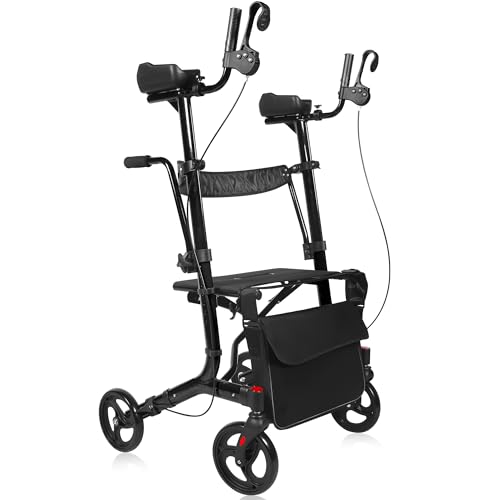
- Stated 450-lb capacity
- 19.8 lbs; folds to 9 inches wide
- Adjustable grips and built-in seat
Best For: High capacity with compact storage
Adjustable Seating Pick
StrollAid Heavy-Duty Upright Rollator

- Stated 450-lb capacity
- Adjustable seat and handles
- Padded seat and breathable backrest
Best For: Adjustable seated support at a stated 450-lb capacity
Capacity-Check Pick
Adjustable Forearm-Support Walker

- Conflicting 220-lb and 420-lb capacity claims
- Four-position removable forearm supports
- Fixed or flexible walking modes; no seat listed
Best For: Forearm support after capacity verification
Portable 300-lb Pick – Black Foldable Upright Walker
For shoppers comparing upright walkers for heavy adults, this black rollator offers a 300-pound capacity in a 22-pound folding frame. It pairs forearm support with a seat for breaks on longer outings.
Best For: Adults under the 300-pound limit who prioritize a lighter walker that folds for storage or travel.
Pros:
- Three handle-length and five height settings allow fit adjustments.
- Includes a 20.5-by-9.8-inch seat, breathable backrest, footrests, and storage bag.
- 9.5-inch anti-slip wheels and hand brakes support controlled movement and stops.
Cons:
- The 300-pound limit is lower than the bariatric models in this roundup.
- The 9.8-inch seat depth may feel shallow; check the dimensions before buying.
This is the portability-focused option rather than a high-capacity bariatric pick. Confirm both the weight rating and seat dimensions fit your needs.
Among upright walkers for heavy adults, this blue model suits buyers who need a 300-pound rating without giving up a folding, 22-pound design. Adjustable forearm supports and a built-in seat make it practical for walks with rest stops.
Best For: Adults under 300 pounds who want a blue, foldable upright rollator with a seat.
Pros:
- Offers three handle-length settings and five height settings.
- Has 9.5-inch anti-slip wheels and an intuitive braking system.
- Includes a 20.5-by-9.8-inch seat, backrest, footrests, and storage bag.
Cons:
- Its 300-pound capacity may not suit buyers needing a higher bariatric rating.
- The seat is 9.8 inches deep, so check whether it provides enough sitting room.
Choose this version if its color and portable layout appeal to you, but prioritize fit and the stated weight limit over appearance.
For buyers researching upright walkers for heavy adults, the Helavo stands out with a 500-pound capacity and a 20.1-inch-wide seat. Its 28.3-inch-wide frame offers room but warrants a doorway check.
Best For: Adults who need up to 500 pounds of rated support and a wider seat.
Pros:
- Provides a 500-pound rating and a 20.1-by-14.2-inch seat.
- Adjustable handles, seat height, and padded backrest help tailor the fit.
- 8-inch flat-free rubber wheels, dual brakes, and reflectors support outdoor use.
- Includes a cup holder, cane holder, and storage bag.
Cons:
- The 28.3-inch frame width may be tight in narrower spaces.
- Its folded width remains 28.3 inches, so check vehicle and storage clearance.
This is the strongest choice here by stated weight capacity. Measure your usual routes and storage space before choosing its extra-wide frame.
The Vive is a middle-ground choice among upright walkers for heavy adults: it supports up to 400 pounds, weighs about 25 pounds, and folds for transport. Its adjustable forearm supports are intended for users 5 feet to 6 feet 4 inches tall.
Best For: Adults seeking a 400-pound-rated walker with adjustable upright support and a folding frame.
Pros:
- Handles adjust from 40 to 50 inches, with contoured armrests and ergonomic grips.
- 9.5-inch flat-free tires suit indoor and outdoor rolling.
- Includes a padded 15-by-17-inch seat, loop brakes, and under-seat storage.
Cons:
- The 400-pound rating is below the Helavo model’s 500-pound limit.
- Its 28-inch frame width calls for a doorway-clearance check.
Consider the Vive if 400 pounds of rated support is sufficient and you want a foldable frame. Check its seat dimensions and overall width against your daily routine.
Best for Narrow Doorways – Folding 450-lb Upright Walker
Among upright walkers for heavy adults, this 450-lb-capacity model stands out for its adjustable 18–22-inch width. Its removable armrests offer forearm support, while a quick-release lets you switch to standard walker mode.
Best For: Adults who need a high-capacity walker for tight indoor spaces and prefer a frame without a seat.
Pros:
- Supports up to 450 lbs with an aluminum H-frame.
- Adjusts from 18 to 22 inches wide and 42 to 51 inches high.
- Folds with one button and weighs 11 lbs.
Cons:
- No seat for rest breaks.
- Standard-walker design may not suit buyers seeking a full rollator.
This is a practical pick when doorway clearance and weight capacity matter more than a built-in seat. Measure your tightest passage before choosing a width setting.
Best Seated Option – Aliseniors Extra-Wide Upright Rollator
For shoppers comparing upright walkers for heavy adults who want a place to pause, this Aliseniors rollator pairs padded armrests with a 20.3-by-9.4-inch seat and backrest. Its stated weight capacity is 300 lbs, so check that limit against your needs.
Best For: Adults within the 300-lb limit who want upright support and a built-in seat for rest breaks.
Pros:
- Extra-wide seat includes a supportive backrest.
- Hand brakes can slow, stop, or lock the wheels.
- Solid 8-inch front wheels, a detachable bag, and a cane holder add convenience.
Cons:
- At 26.2 inches wide overall, it may not fit every doorway.
- 300-lb capacity is lower than that of the two 450-lb walkers in this roundup.
Choose this model for seated breaks and rollator-style mobility rather than maximum capacity or narrow-doorway clearance. It folds flat for storage, but measure doorways before ordering.
Best Forearm Cradle – Folding Narrow Platform Walker
This platform-style option for upright walkers for heavy adults provides padded forearm troughs and a stated 450-lb capacity. Its width adjusts from 18 to 22 inches, making it worth considering where a wider rollator would be difficult to maneuver.
Best For: Adults who prefer full forearm cradles and need a narrow, high-capacity walking frame.
Pros:
- Four-level adjustable padded forearm troughs provide arm support.
- Adjusts from 18 to 22 inches wide and 42 to 51 inches high.
- Trigger-release folding helps with storage and travel.
- 5-inch front wheels pair with rear glide caps.
Cons:
- No built-in seat.
- Front wheels and rear glide caps differ from a four-wheel rollator setup.
The forearm cradles distinguish this model from standard hand-grip walkers. If you need seated breaks or four rolling wheels, look at a rollator instead.
Lightweight 450-lb Pick – Sunderwell Foldable Upright Walker
Among upright walkers for heavy adults, the Sunderwell pairs a stated 450-lb capacity with a relatively light 19.8-lb frame. It is worth considering if you need a seated rollator that is easier to fold and store.
Best For: Buyers who prioritize a high stated weight capacity and compact storage.
Pros:
- Supports up to 450 lbs, according to the product specifications.
- Folds to a stated 9-inch width and weighs 19.8 lbs.
- Adjustable grips span 44.5 to 50.5 inches; a built-in seat offers a place to rest.
Cons:
- Seat dimensions are not provided, so check the fit before buying.
- The listed grip-height range may not suit every user.
Its combination of capacity, folding width, and 7.9-inch front wheels makes it a practical option for mixed indoor and outdoor use. Confirm that the grip height and seat fit your needs.
Adjustable Seating Pick – StrollAid Heavy-Duty Upright Rollator
The StrollAid is one of the upright walkers for heavy adults to consider when seat fit matters as much as the stated 450-lb capacity. Both its seat and handles adjust, and its forearm supports are designed to spread pressure across the elbows.
Best For: Users who want adjustable seating and forearm support in a 450-lb-rated rollator.
Pros:
- Seat adjusts from 20.1 to 23.6 inches; handles adjust from 39.8 to 46.9 inches.
- Includes a 1.6-inch-thick breathable seat, 8.1-inch backrest, and sit-to-stand handles.
- Eight-inch wheels and swiveling front wheels are intended for varied terrain and easier steering.
Cons:
- At 27.6 lbs, it is heavier than the 19.8-lb Sunderwell model in this roundup.
- Its listed 24.8-inch width should be checked against narrow doorways and storage spaces.
This model stands out for its separate seat and handle adjustments. Check those ranges against your measurements rather than relying on the broad user-height claim alone.
Capacity-Check Pick – Adjustable Forearm-Support Walker
This forearm-support model has useful adjustments, but buyers comparing upright walkers for heavy adults should verify its load rating before considering it: the supplied bullet claims 220 lbs, while the specifications list 420 lbs. It is a standard walker, not a seated rollator.
Best For: Buyers seeking adjustable forearm supports who can confirm the correct capacity with the seller.
Pros:
- Removable PU forearm supports offer four horizontal positions.
- Seven height settings span a stated 40 to 44 inches.
- Fixed and flexible frame modes offer two walking setups; the listed weight is 12 lbs.
Cons:
- Capacity claims conflict: 220 lbs in the bullet points versus 420 lbs in the specifications.
- No rest seat is listed.
- Five-inch dual wheels differ from the larger wheels on the two seated rollators here.
The adjustable supports and selectable frame modes may appeal to users who do not need a seat. Do not rely on the higher capacity figure until the manufacturer or seller resolves the discrepancy.
How We Picked the Best Upright Walkers for Heavy Adults
We focused on the specifications that matter most for heavier users: stated weight capacity, usable seat space, forearm-support adjustability, frame dimensions, and practical features such as brakes and folding. The selection includes extra-wide bariatric models, higher-capacity options, and narrower walkers for tighter spaces. Some listings have similar or repeated names, so confirm the exact model and specifications with the seller before ordering. A listed capacity is a starting point, not proof that a walker will fit your body or home.
Quick Comparison
The clearest split is between capacity and footprint. The listed Helavo extra-wide model has a 500 lb rating, while the Vive bariatric model is listed at 400 lb. A narrow model and the Sunderwell walker are listed at 450 lb; Sunderwell is also described as weighing 19.8 lb. Several other selections are listed at 300 lb or do not state a capacity in the provided product name. Treat those figures as listing claims to verify, and compare seat dimensions, overall width, and folded size before deciding. Two entries share the same 300 lb product name; check whether they are distinct listings or the same walker offered twice.
Key Buying Factors for Upright Walkers for Heavy Adults
Weight Rating and Stable Fit
Choose a stated capacity above your body weight, allowing for clothing and anything you carry. Check the manufacturer’s instructions for any separate seat limit. More capacity does not automatically mean more stability: look for a frame that feels secure at your walking pace, wheels suited to your usual surfaces, and brakes you can operate confidently.
Seat, Support, and Adjustment
Check the seat’s usable width and height, not just an “extra-wide” label. You should be able to sit without squeezing between the frame sides and stand up without excessive effort. Forearm rests should adjust to a comfortable height without forcing you to hunch or reach forward. If you have shoulder, elbow, or grip limitations, consider an in-person fitting with a clinician or mobility-equipment specialist.
Home Clearance and Transport
Measure your narrowest doorway, hallway turns, and the space around your usual chair. Compare those measurements with the walker’s overall width, including protruding components. If you lift it into a vehicle, check its actual weight, folding method, and folded dimensions; “lightweight” is relative for a heavy-duty frame.
Who Should Buy Which Upright Walkers for Heavy Adults?
Start with the 500 lb extra-wide option if you need the highest stated capacity in this group and have room for a wider frame. Consider a 400–450 lb model if its seat and armrests fit you better, rather than choosing by rating alone. Narrow adjustable models may suit smaller doorways, provided their usable seat width and manufacturer-rated capacity meet your needs. A folding option makes sense when storage or car travel is a priority, but test whether you can fold and lift it safely. If a listing omits critical dimensions or its capacity is unclear, ask the seller before buying—or choose a model with complete specifications and a workable return policy.